WisDOT Research Project 0092-25-23

Enhanced Light
Crosswalk Illumination

Blue-spectrum lighting measurably improves nighttime pedestrian safety. Drivers detected pedestrians ~40 ft sooner than the existing baseline and ~26 ft sooner than 4000 K white, with faster reaction times.

0nighttime field rounds
0Wisconsin study sites
0spectral configurations
+19 ftearlier detection · Milwaukee
+63 ftearlier detection · Madison
Research Team

UW–Milwaukee · UW–Madison · TAPCO

Portrait of Xiaowei (Tom) ShiXiaowei (Tom) Shi, Ph.D.Principal InvestigatorAssistant Professor, UW–Milwaukee
tomshi@uwm.edu
Portrait of Xiao QinXiao Qin, P.E., Ph.D.Co-PIProfessor, UW–Milwaukee
qinx@uwm.edu
Portrait of Xiaopeng LiXiaopeng Li, P.E., Ph.D.Co-PIProfessor, UW–Madison
xli2485@wisc.edu
Portrait of Brian Scharles Sr.Brian Scharles Sr.Co-PIDirector of Product Innovation, TAPCO
brians@tapconet.com
Portrait of Muhammad FahadMuhammad FahadGraduate Research AssistantUW–Milwaukee
muhamm72@uwm.edu

Student team: Narayan Rai · Xiao Liang (UWM) · Bofeng Cao · Chengyuan Ma · Hangyu Li · Keke Long · Jiaxi Liu (UW–Madison) · Aleischa Kronshagen · Denise Lawien (TAPCO)
With sincere thanks to the WisDOT Project Oversight Committee and all participants.


Wisconsin Department of Transportation logo
University of Wisconsin–Milwaukee logo
University of Wisconsin–Madison logo
TAPCO: Safe travels logo
The Problem

Pedestrians are hardest to see when they need it most

Nighttime visibility is a persistent safety problem, and current guidance leaves three gaps.

Deaths peak at night

Pedestrian deaths peak at night; darkness and dark clothing slow driver response.

Existing treatments fall short

RRFBs improve yielding but do not light the pedestrian. HAWK signals are costly and not feasible everywhere. Streetlights light the pavement, not the pedestrian.

Three gaps in guidance

Spectrum: which spectrum performs best? Geometry: which installation geometry works? Transfer: how to generalize site results to other roads?

The System

SafeWalk™ prototype with seven adjustable spectra

Purpose-built LED crosswalk illuminator (TAPCO SafeWalk 2.0), configured for field research.

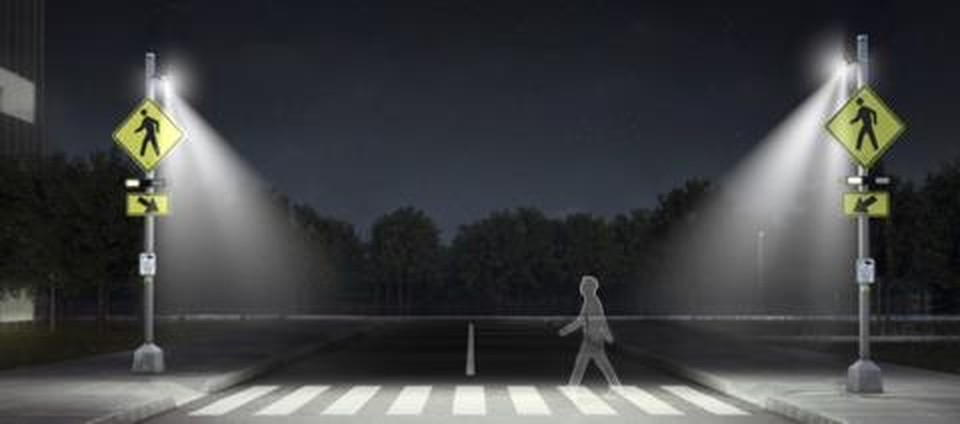
SafeWalk crosswalk illuminators mounted on two poles lighting a pedestrian at a midblock crosswalk at night
SafeWalk™ crosswalk illuminator: dual-pole layout lighting the pedestrian, not just the pavement
≥ 20 lux vertical at pedestrian plane 12–15 ft mounting Adjustable beam aiming 25° × 24° beam · ≈820 cd/klm IP66 · −40°F to 176°F 120 mph wind rating ≈2 W per LED · 12 V DC Solar + battery compatible
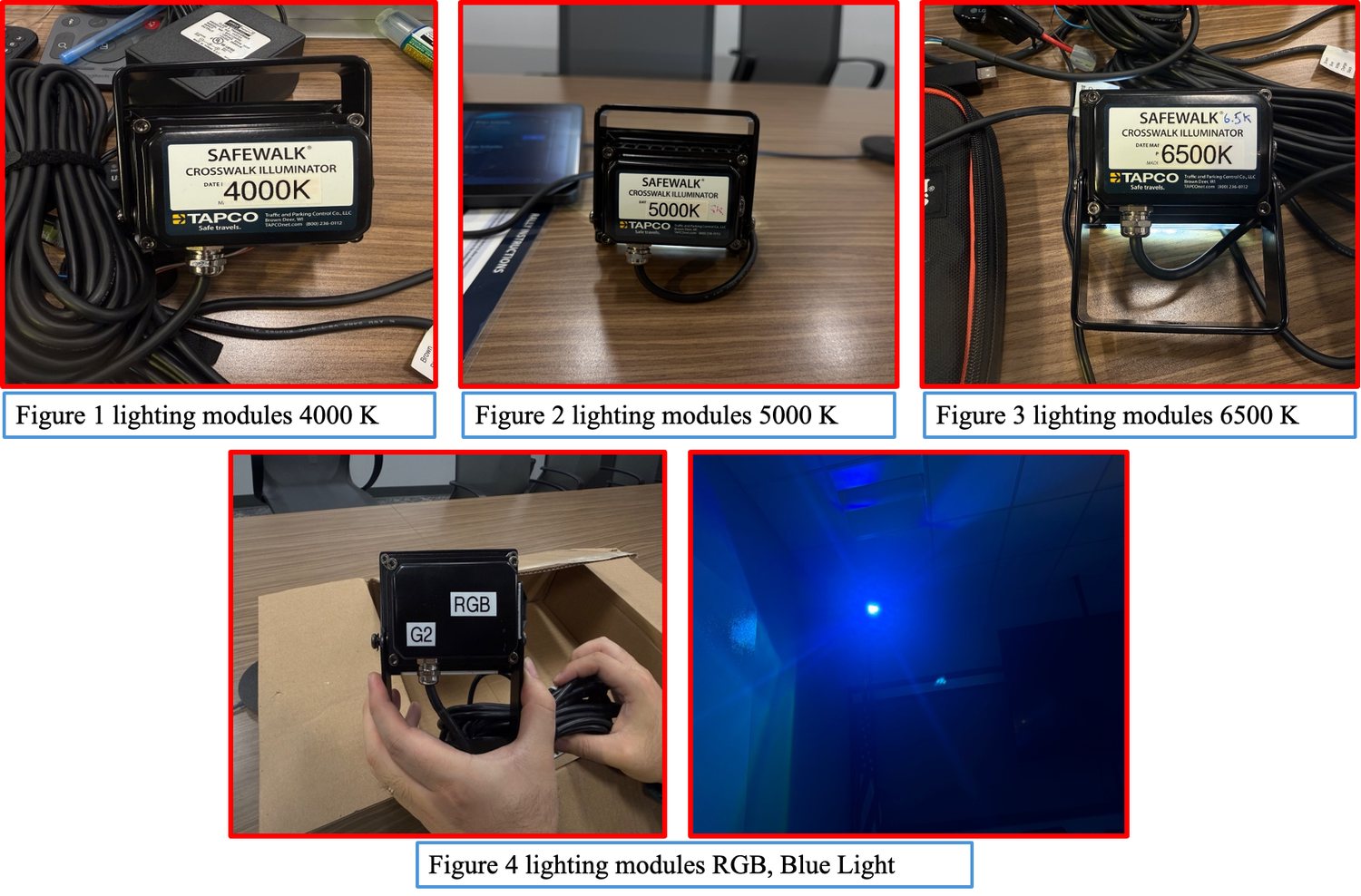
Prototype spectral configurations assembled for testing
Prototype modules assembled for testing: 4000 K · 5000 K · 6500 K · RGB blue-light
ConfigurationTypeRationale
4000 KNeutral whiteFHWA / agency reference
5000 KCool whiteOne step above standard
6500 KDaylight whiteUpper white-light boundary
Blue BaselineBlue-shifted LEDReference blue configuration
Ice BlueBlue-shifted LEDBlue + white mix, highest luminance
Sky BlueBlue-shifted LEDMid-intensity mix
Pure Royal BlueSaturated blueMaximum blue saturation

Seven spectral configurations: the agency-recommended white range plus the blue-shifted range never before field-tested in Wisconsin.

Field Testing

281 nighttime rounds at two Wisconsin sites

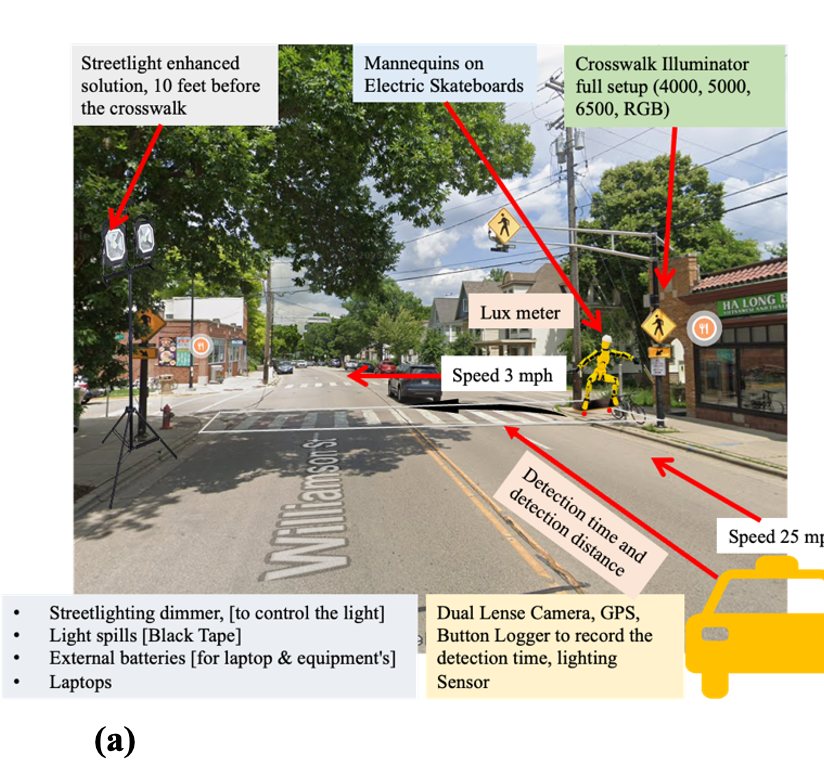
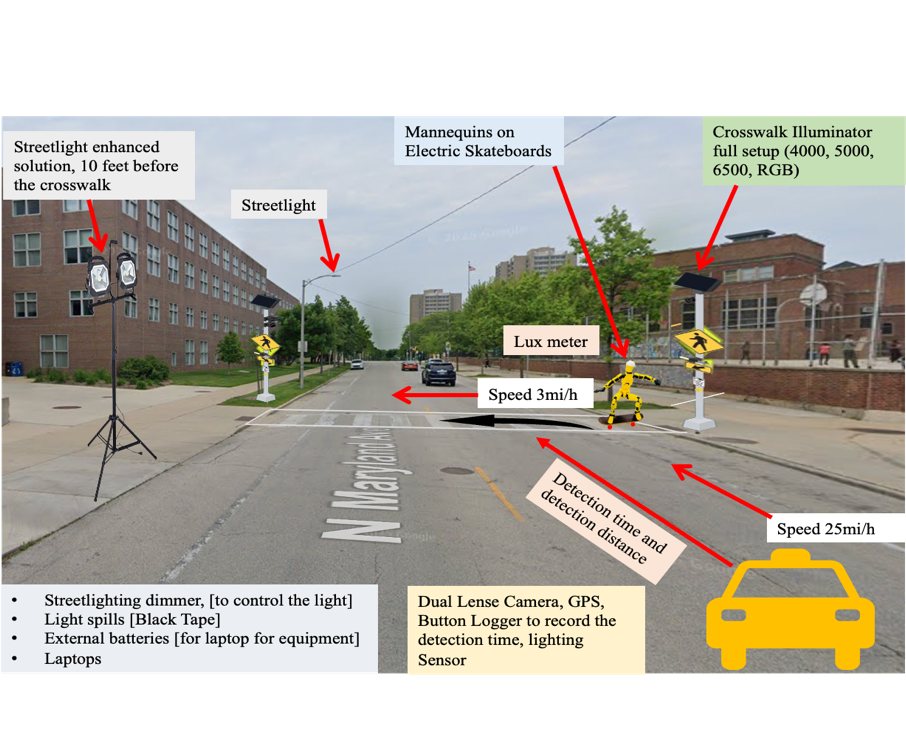
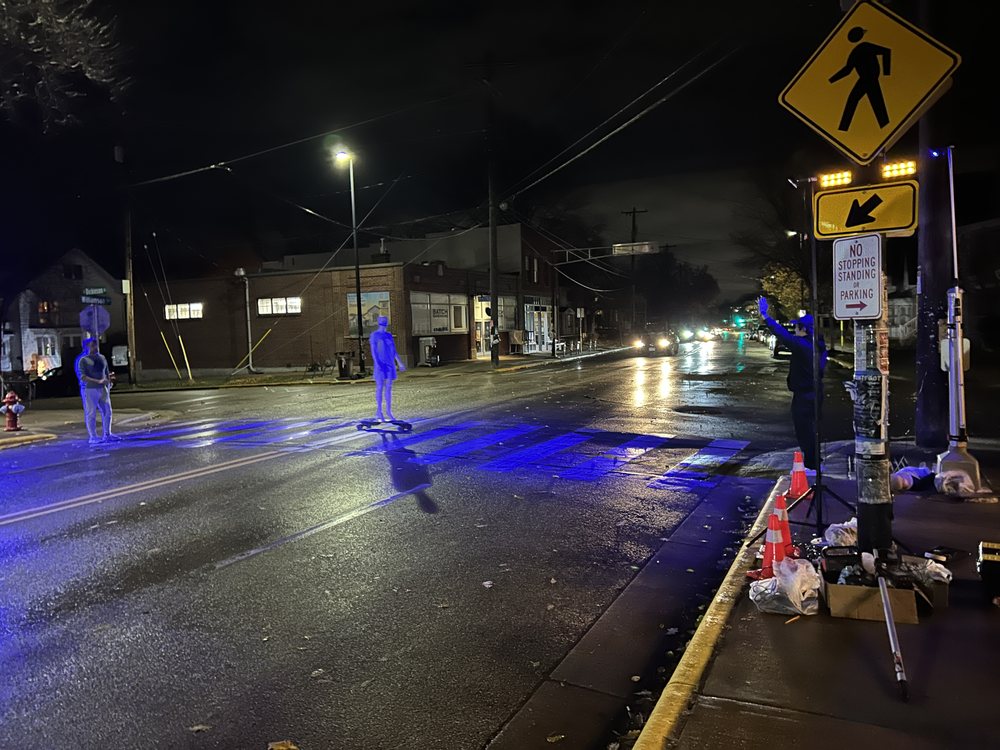
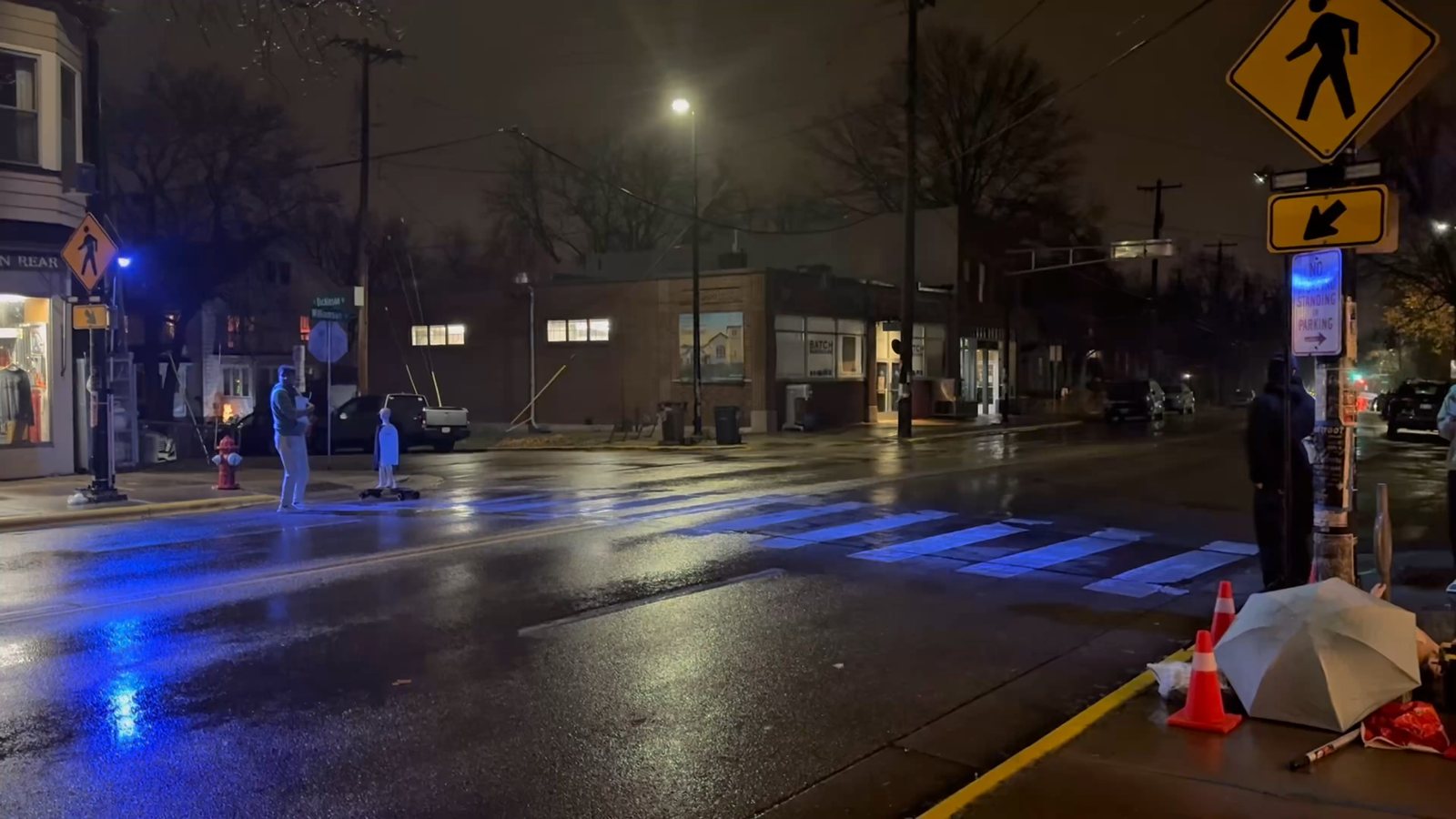
An instrumented probe vehicle approached the crosswalk while a mannequin on a remote-controlled electric skateboard crossed, creating repeatable pedestrian events on real roads, on real nights.
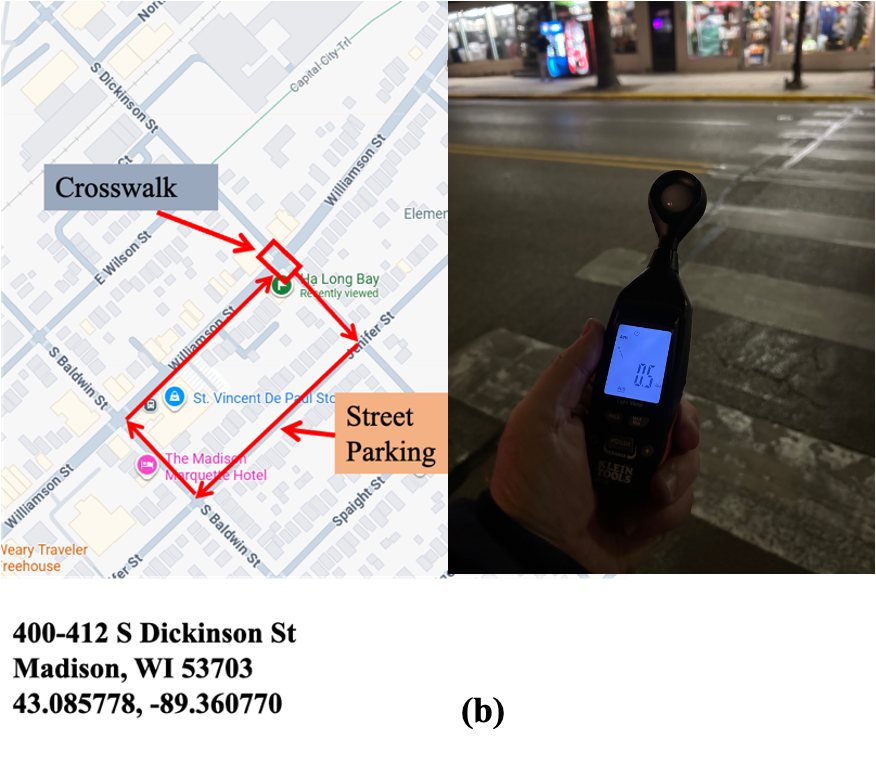
Madison field experiment layout Madison site map and baseline lux measurement
Madison · 104 rounds

Williamson St & S Dickinson St

Wider 4-lane urban roadway · existing RRFB + push buttons · visually complex background.

Baseline ≈ 0.5 lux Heights: 10 / 12.5 / 15 ft RRFB present
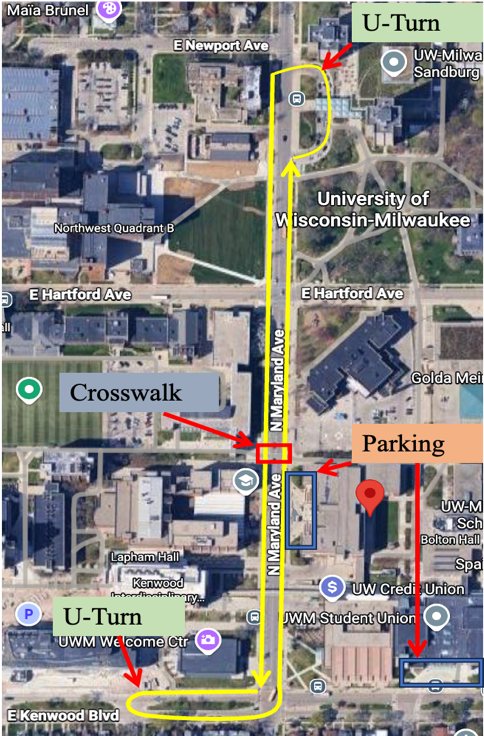
Milwaukee field experiment layout Milwaukee site map with U-turn test route
Milwaukee · 177 rounds

N Maryland Ave · UWM campus

Two-lane campus roadway · no RRFB or push button · ambient street lighting.

Baseline ≈ 13 lux Heights: 7.5 / 10 / 12.5 ft Lateral: 0 / 9.5 / 16.5 ft

What we varied

FactorLevels
Lighting spectrum4000 K · 5000 K · 6500 K · 4 blue configs
Mounting height3 heights per site
Lateral distance0 / 9.5 / 16.5 ft (Milwaukee)
Pedestrian targetAdult & child mannequins
ClothingDark blue & white
ObstructionClear · small vehicle · van parked
Weather / ambientClear night · light rain · ± streetlight

Instrumentation

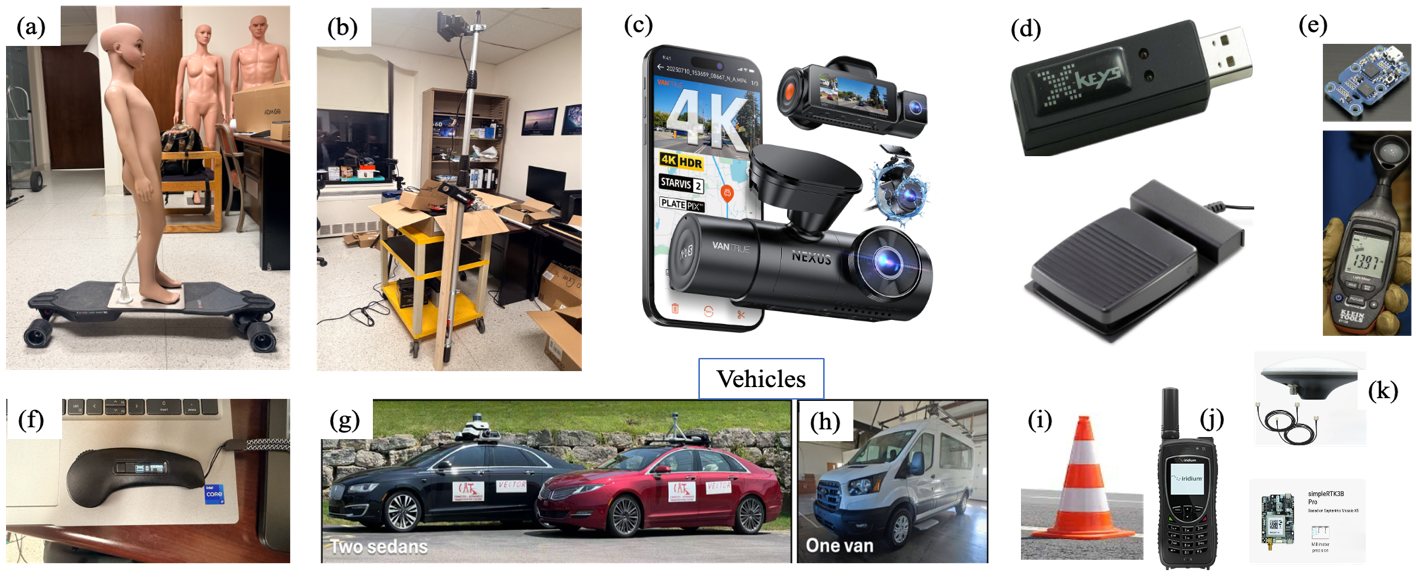
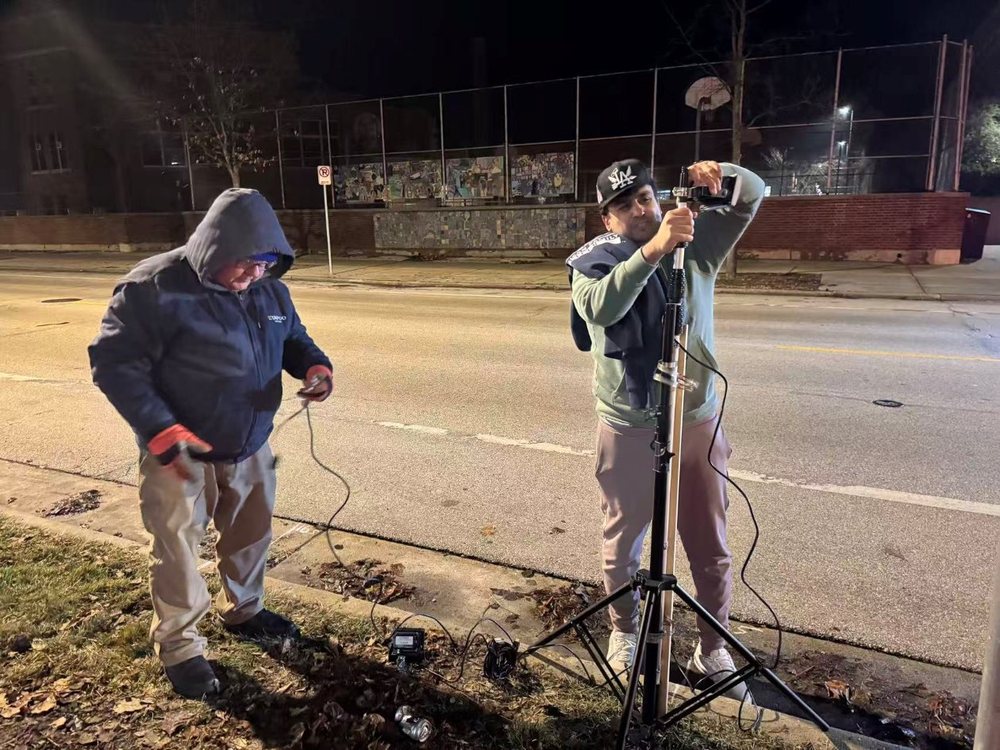
Field hardware: mannequins on skateboards, cameras, GPS, brake logger, lux meter, test vehicles
Field hardware: mannequin skateboards · 4K dual cameras · brake foot switch · lux meter · GPS · two sedans + one van
125 Hz GPS Roadway camera Driver IR camera Brake logger Lux meter Remote skateboard control

Drivers were never told when or where the mannequin would cross.
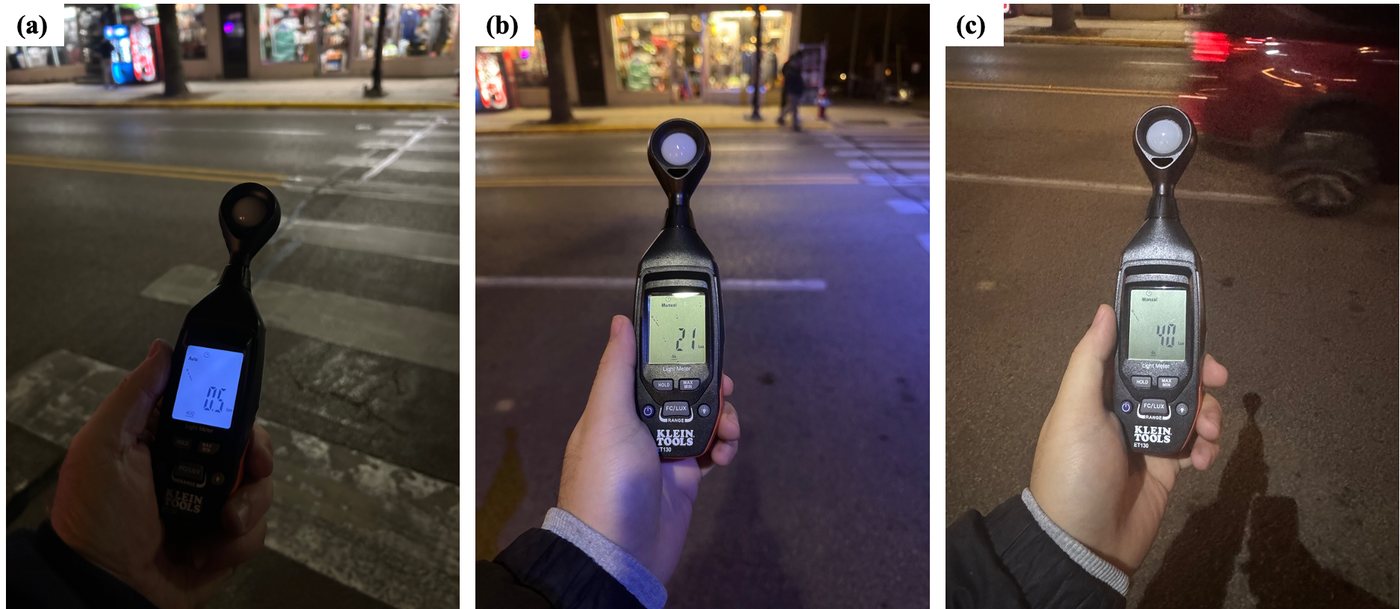
Measured illuminance at the crosswalk (Madison)

≈ 0.5 luxBaseline · no enhanced lighting
≈ 21 luxEnhanced crosswalk lighting
≈ 40 luxEnhanced + floodlight (streetlight sim.)
Lux meter readings: 0.5, 21, and 40 lux
Lux meter readings: (a) 0.5 lux baseline · (b) 21 lux enhanced · (c) 40 lux with floodlight
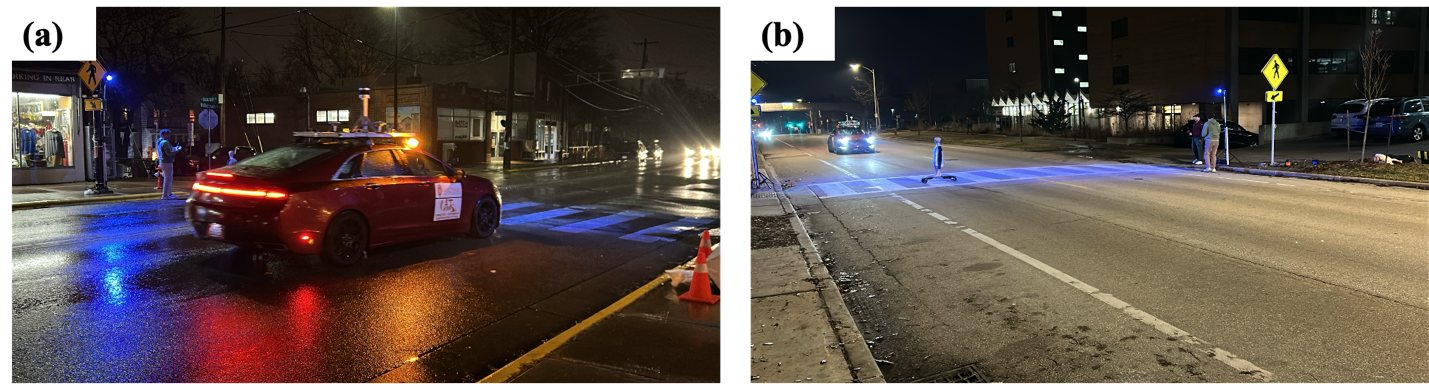
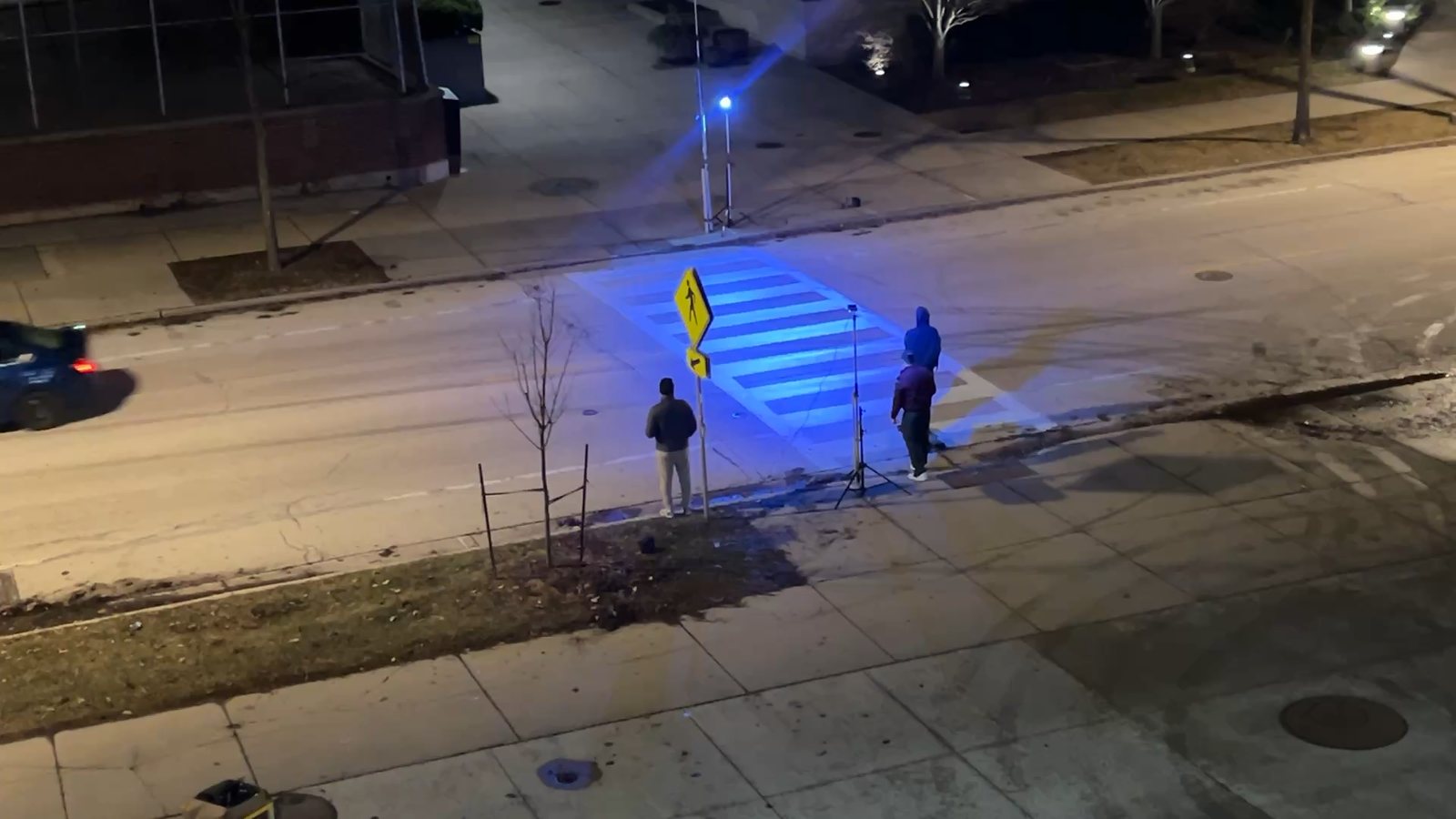
Nighttime field testing setup at Madison and Milwaukee
Nighttime testing: (a) Madison, wet pavement · (b) Milwaukee, blue-lit crosswalk

Field effort under harsh and tough conditions

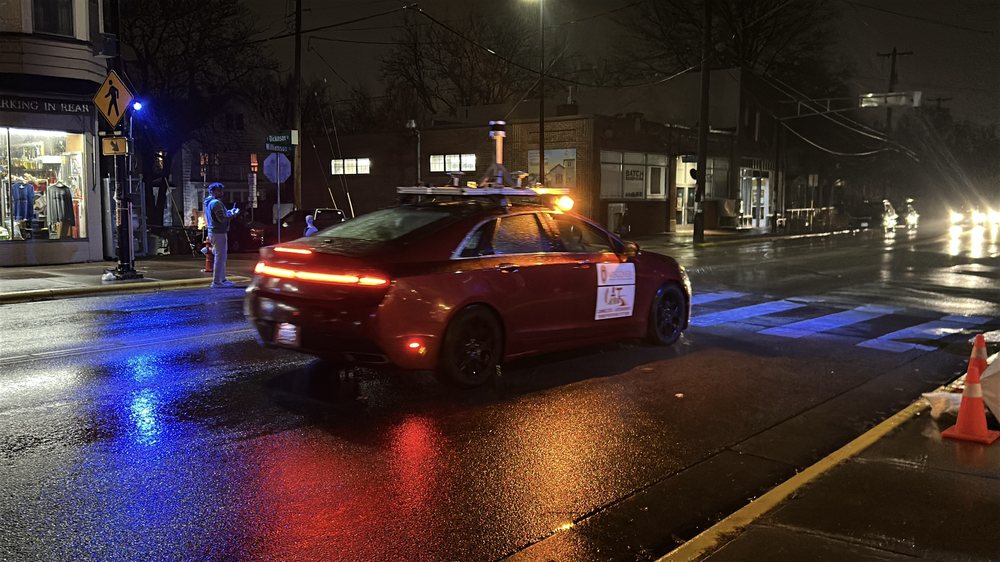
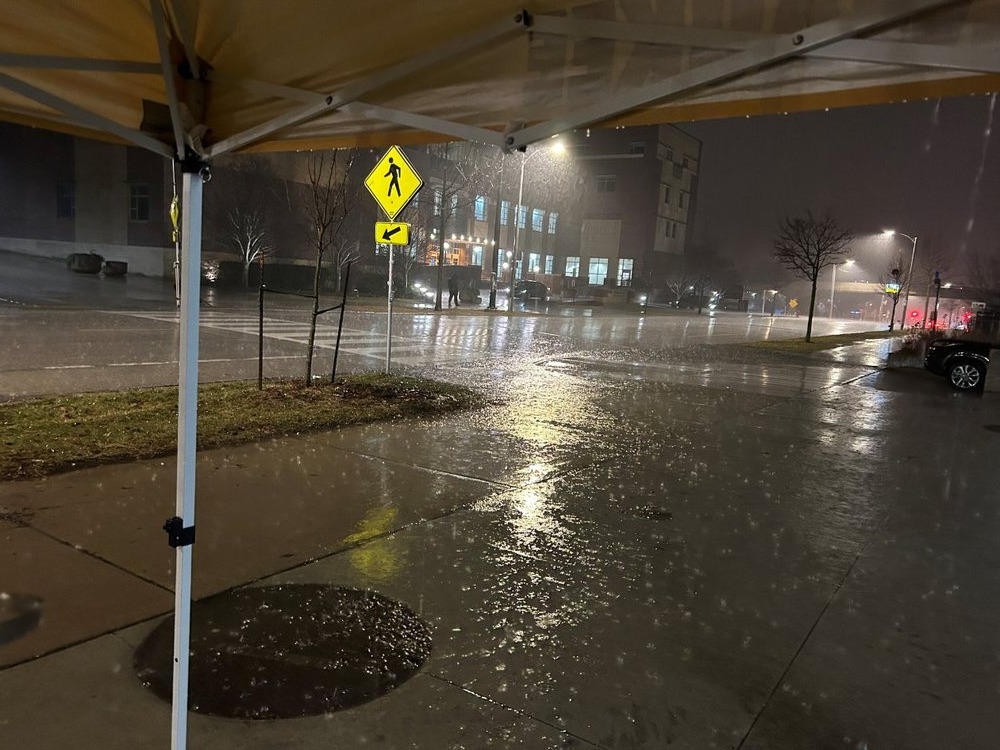
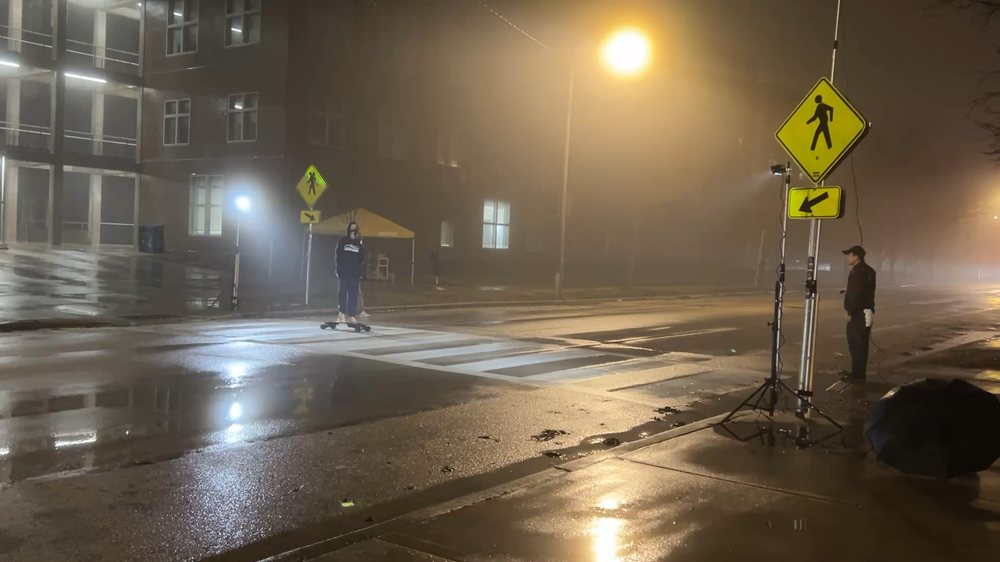
All 281 rounds ran at night, including light rain, wet pavement, and late-season cold.
Instrumented test vehicle on wet night street Field tent on flooded street Mannequin crossing in fog at night Night crosswalk testing Team setting up equipment in the cold Wide view of the wet Madison test street at night
How We Measured

Deep-learning eye tracking of real drivers

A CNN pipeline found the exact frame each driver first recognized the pedestrian, then synchronized it with GPS, speed, and brake records.

Collect

GPS · roadway video · driver IR video · brake logs, all synchronized.

Synchronize

3.5 s event clips centered on each brake press.

Detect

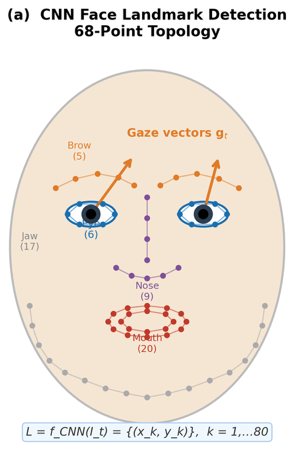
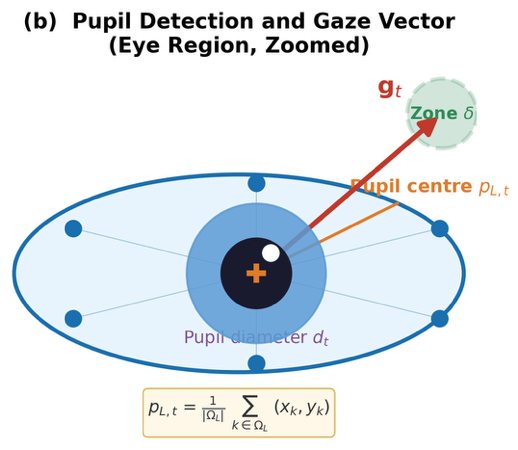
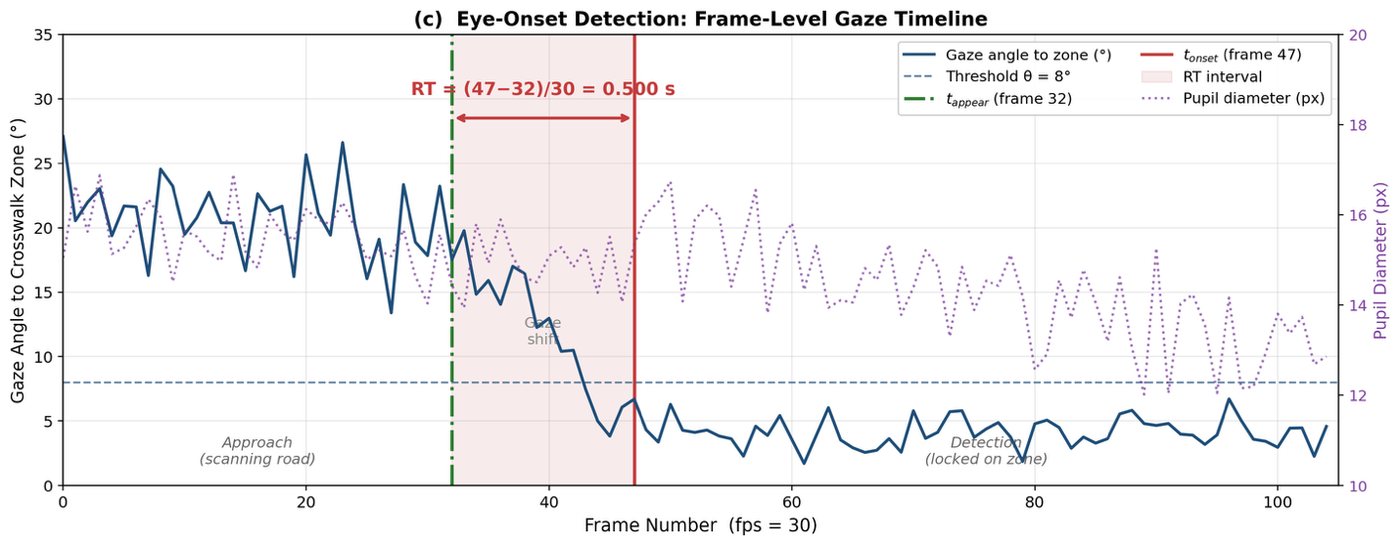
CNN face landmarks → gaze vector → first recognition frame.

Measure

RT = brake − eye onset · DD = distance at onset.

CNN face landmark localization
(a) CNN face landmarks
Pupil center and gaze vector estimation
(b) Pupil center & gaze vector
Frame-level gaze timeline with eye onset
(c) Gaze timeline → eye onset → RT
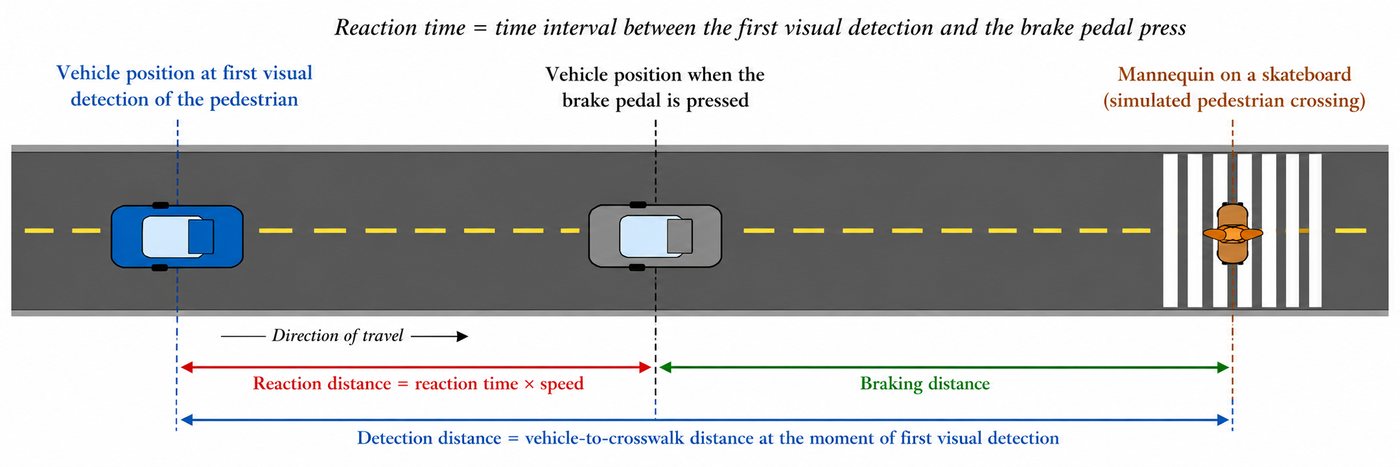
RT

Reaction Time

First recognition → brake press. Shorter is better.

DD

Detection Distance

Vehicle-to-crosswalk distance at first recognition. Longer is better.

Conceptual top view of reaction time and detection distance
Conceptual top view: reaction distance + braking distance, all referenced to a fixed crosswalk location
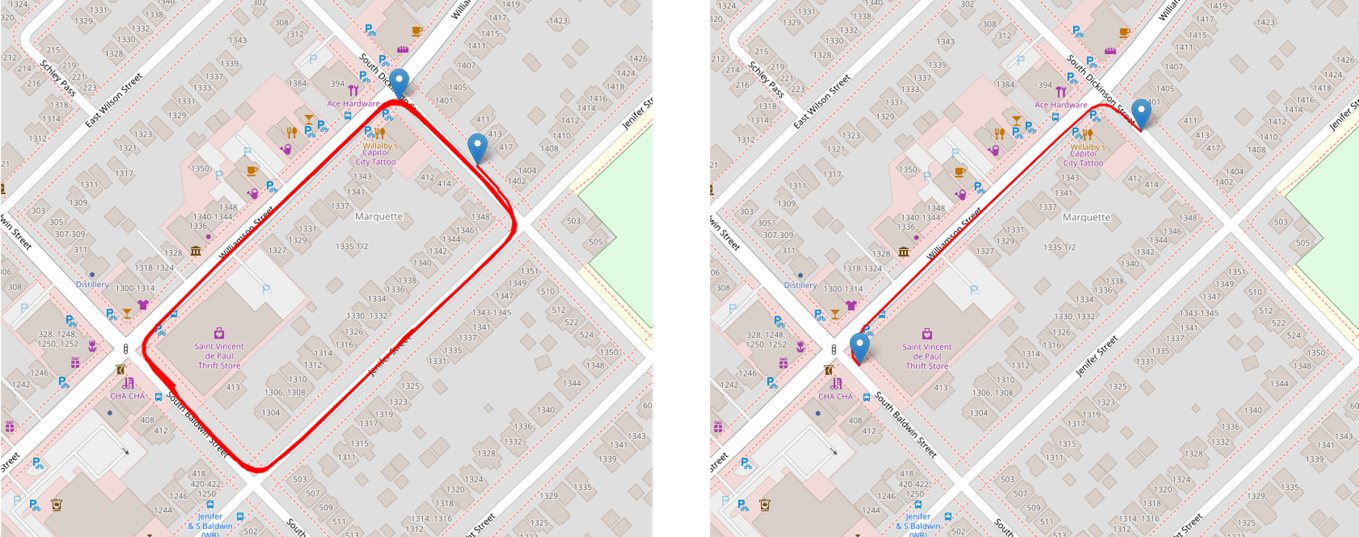
GPS trajectory mapping for the Madison experiment
125 Hz GPS trajectory mapping: Madison approach path verification

Quality control

Every eye onset was verified against the driver video, the roadway video, and the brake-event timestamp before analysis.

Face detection 95.6% combined 93.8% Milwaukee 98.6% Madison 30 fps IR video · ≈33 ms resolution Blinks, saccades & head pose filtered from noise

Only trials passing synchronization, video, GPS, and brake-match checks entered the final analysis.

Watch

See the system in action

Live nighttime demonstrations at both sites, and the eye-tracking pipeline running on driver video.

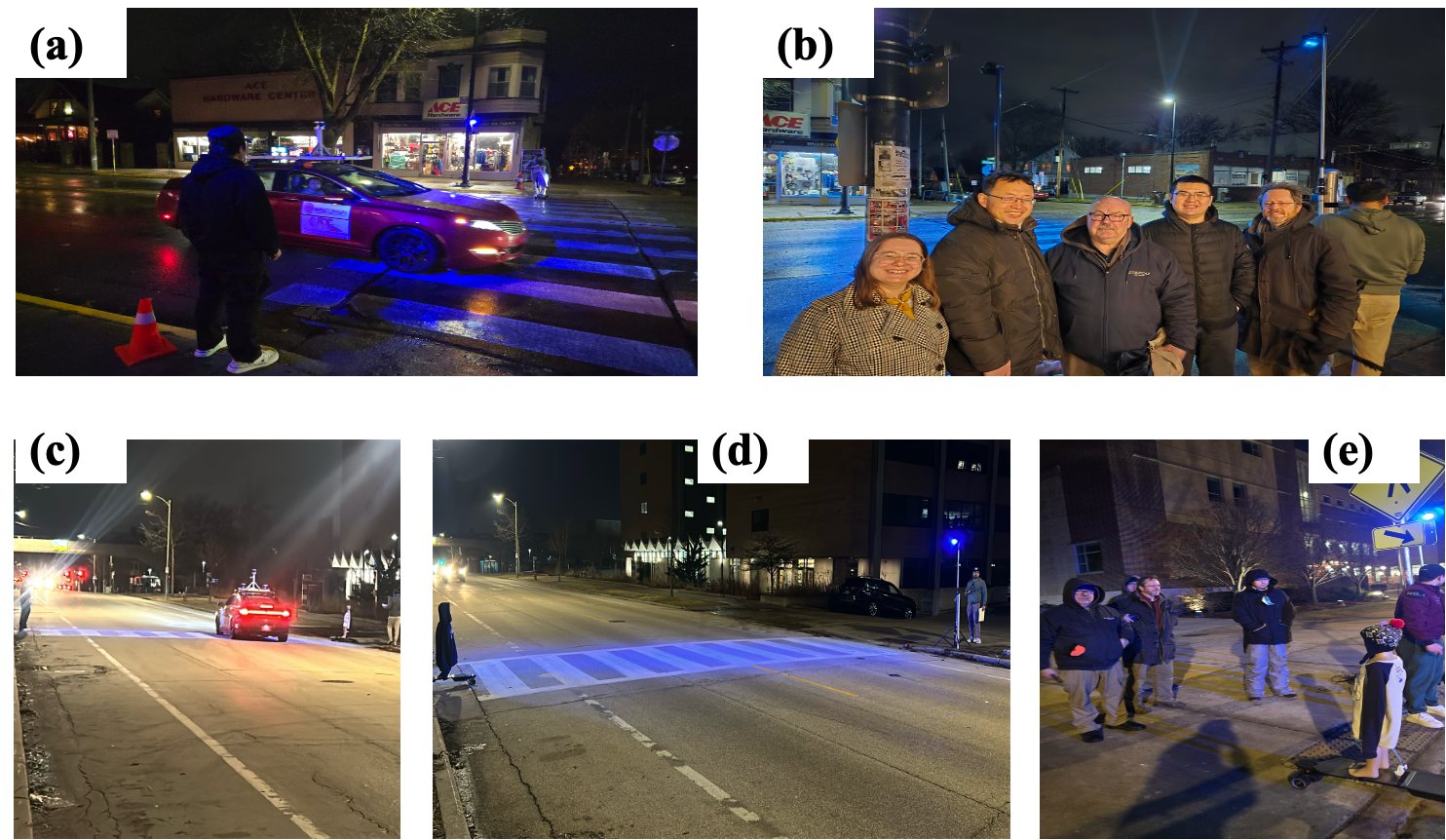
Enhanced lighting demonstrations at the Madison and Milwaukee sites
Live demonstrations at Madison (a, b) and Milwaukee (c–e)

Live demonstrations for the WisDOT POC

Held at both study sites under real nighttime conditions. The committee observed illumination coverage, vehicle approach, and mannequin crossings first-hand.

Madison: wider urban roadway · RRFB · wet pavement Milwaukee: two-lane campus roadway · pedestrian activity Strong interest in the blue-light option at SE WI Transportation Symposium 2025
▶ Add YouTube ID for the Milwaukee demo
(edit VIDEO_IDS in index.html)
Milwaukee Demonstration

N Maryland Ave · two-lane campus roadway

▶ Add YouTube ID for the Madison demo
(edit VIDEO_IDS in index.html)
Madison Demonstration

Williamson St & S Dickinson St · RRFB site

▶ Add YouTube ID for the eye-tracking demo
(edit VIDEO_IDS in index.html)
Eye-Tracking Pipeline

Driver-facing infrared video · onset detection

Demonstrated live to the WisDOT Project Oversight Committee at both sites, and at the SE Wisconsin Transportation Symposium 2025.

Results

Blue-spectrum lighting won at both sites

Baseline vs. enhanced lighting: measured driver reaction time and detection distance.

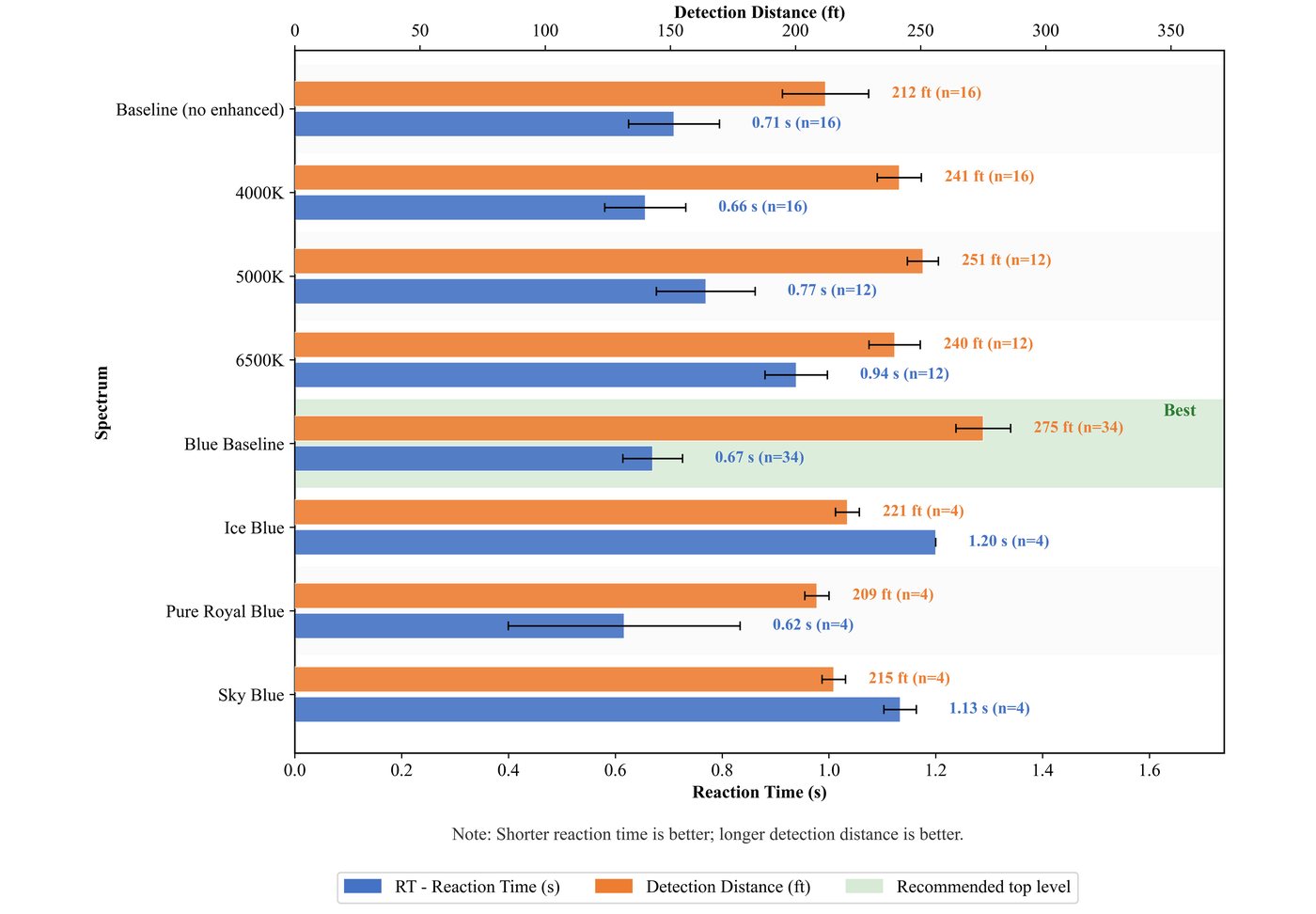
Madison · Blue Baseline

Baseline · RT 0.71 s212 ft
Enhanced · RT 0.67 s275 ft
+63 ft earlier detection · faster reaction

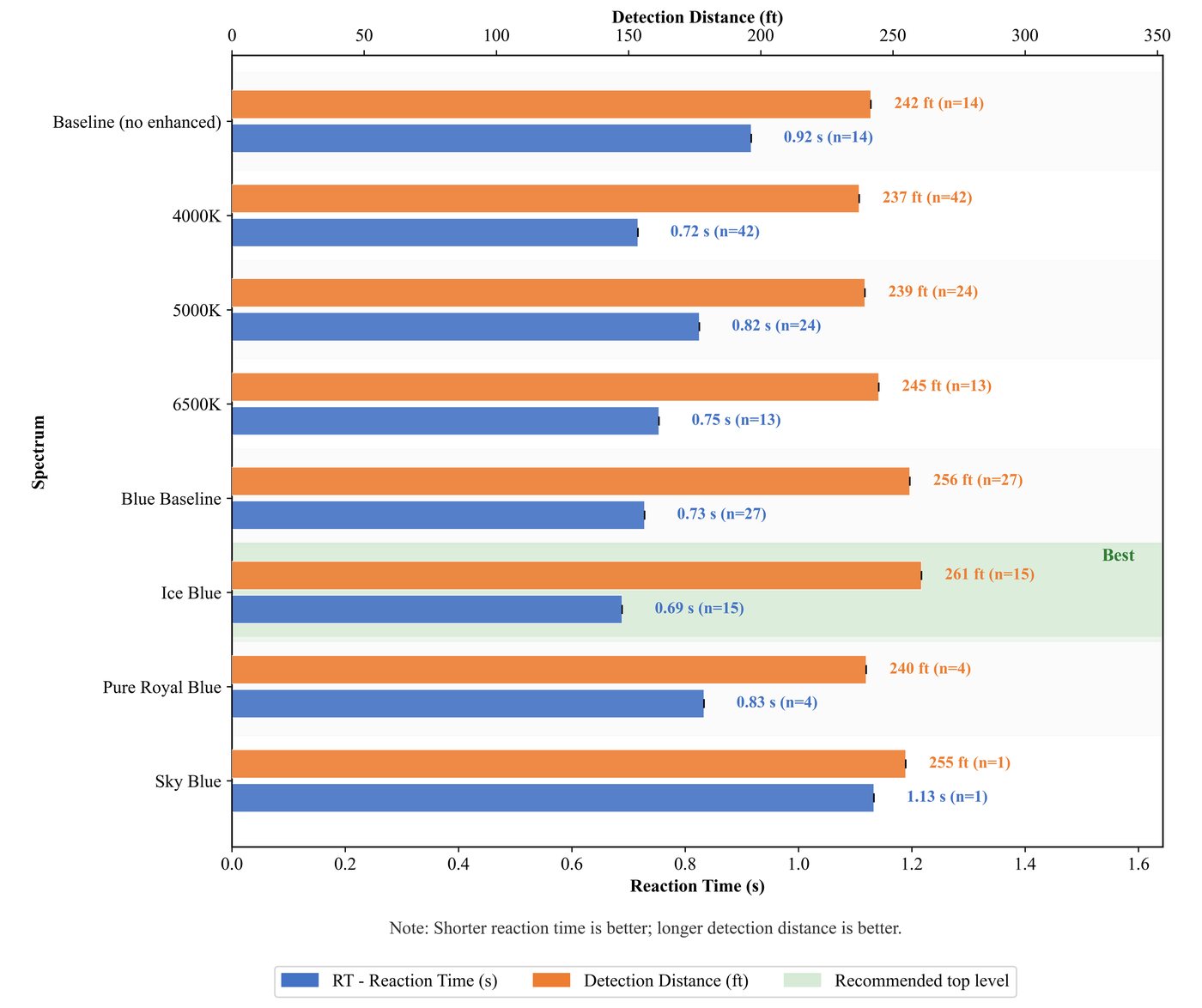
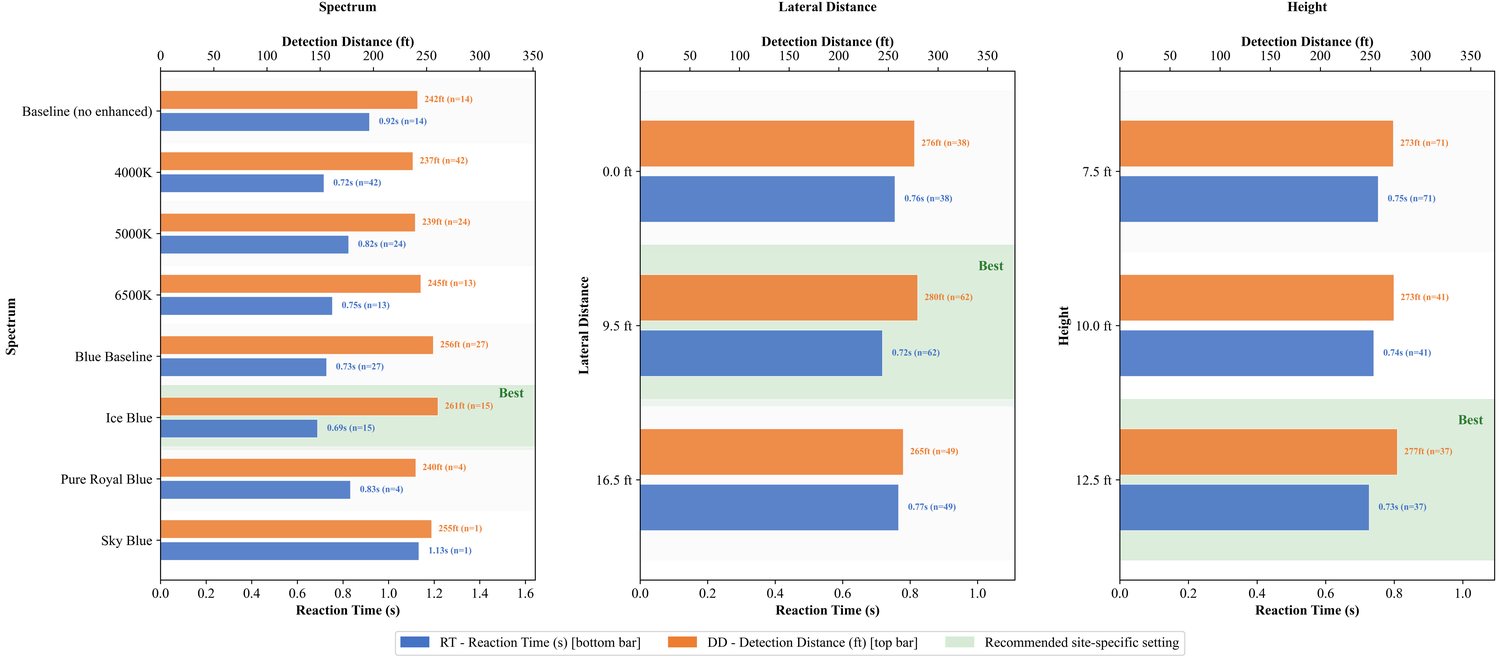
Milwaukee · Ice Blue

Baseline · RT 0.92 s242 ft
Enhanced · RT 0.69 s261 ft
+19 ft earlier detection · RT −0.23 s

Overall: blue-spectrum enhanced lighting let drivers detect the pedestrian ~40 ft sooner than baseline and ~26 ft sooner than conventional 4000 K white, with comparable or faster reaction times.

Spectrum comparison

SpectrumRT (s)DD (ft)
Baseline (no enhanced)0.92242.0
4000 K0.72237.2
5000 K0.82239.4
6500 K0.75244.6
Blue Baseline0.73256.4
Ice Blue ★0.69260.8
Pure Royal Blue0.83239.9
Sky Blue1.13254.8

Ice Blue strongest overall: one of the fastest reaction times with a practical detection distance. Blue Baseline beat 4000 K by +19.2 ft DD at similar RT.

Milwaukee spectrum performance comparison
Milwaukee spectrum performance: RT & DD
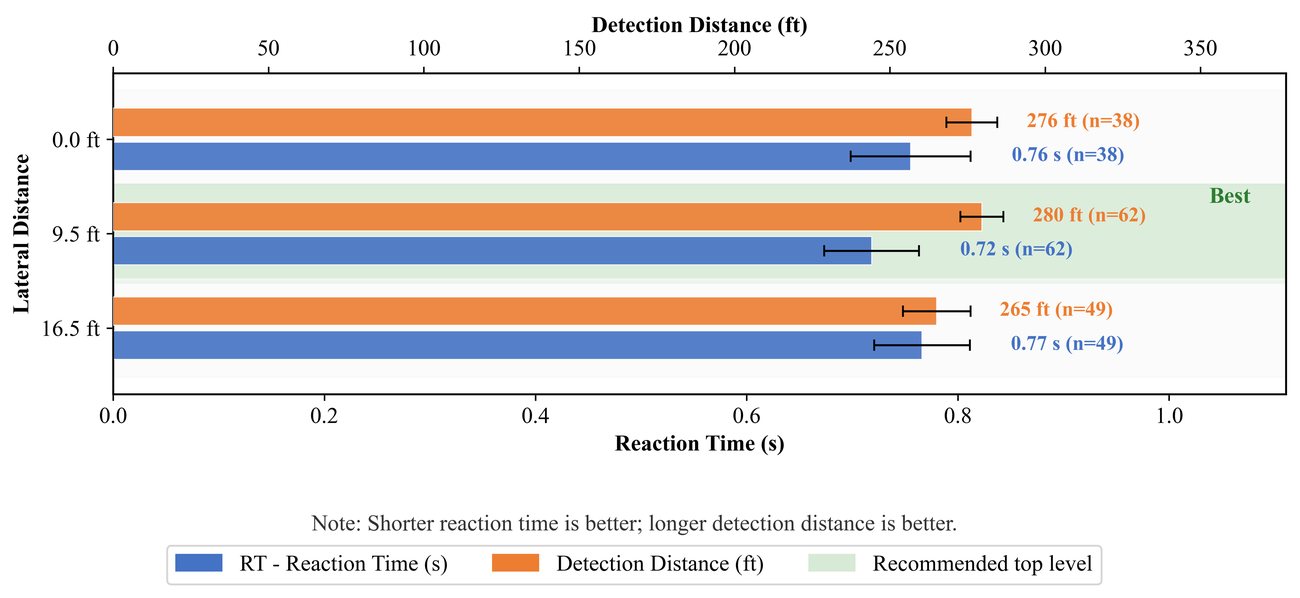
Milwaukee lateral distance comparison
Lateral placement: best: 9.5 ft
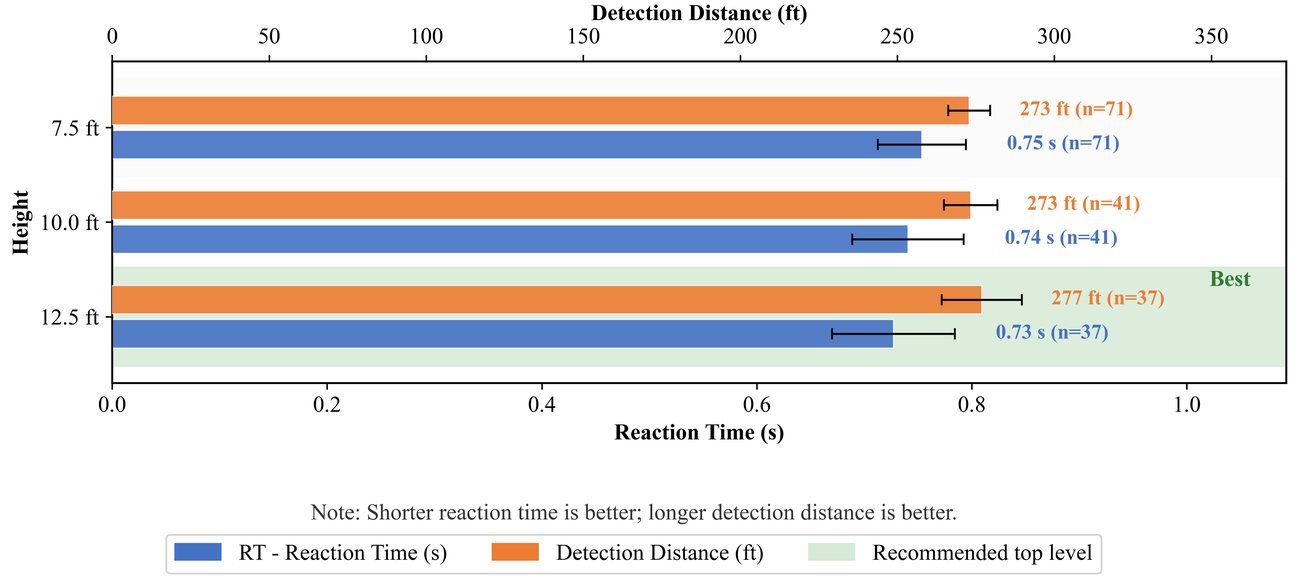
Milwaukee mounting height comparison
Mounting height: best: 12.5 ft

Recommended Milwaukee configuration

Spectrum: Ice Blue Mounting height: 12.5 ft Lateral distance: 9.5 ft Spill control: none

Strongest balance of RT, DD, sample size, and installation practicality: the two-lane design basis.

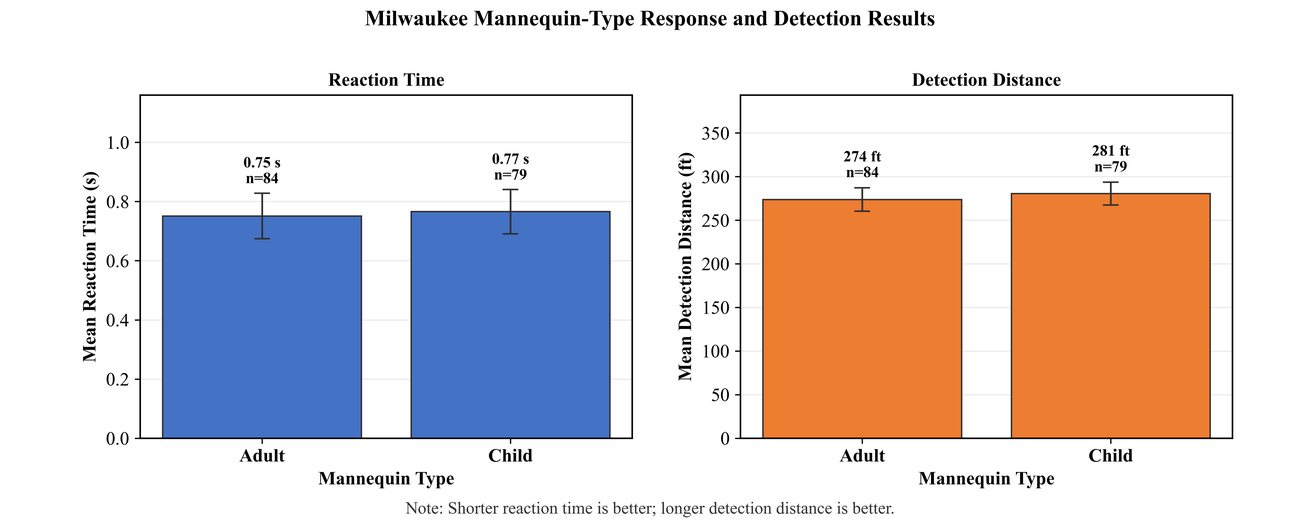
Milwaukee mannequin type results
Mannequin type

Adult vs. child differences were small relative to overlapping error bars.

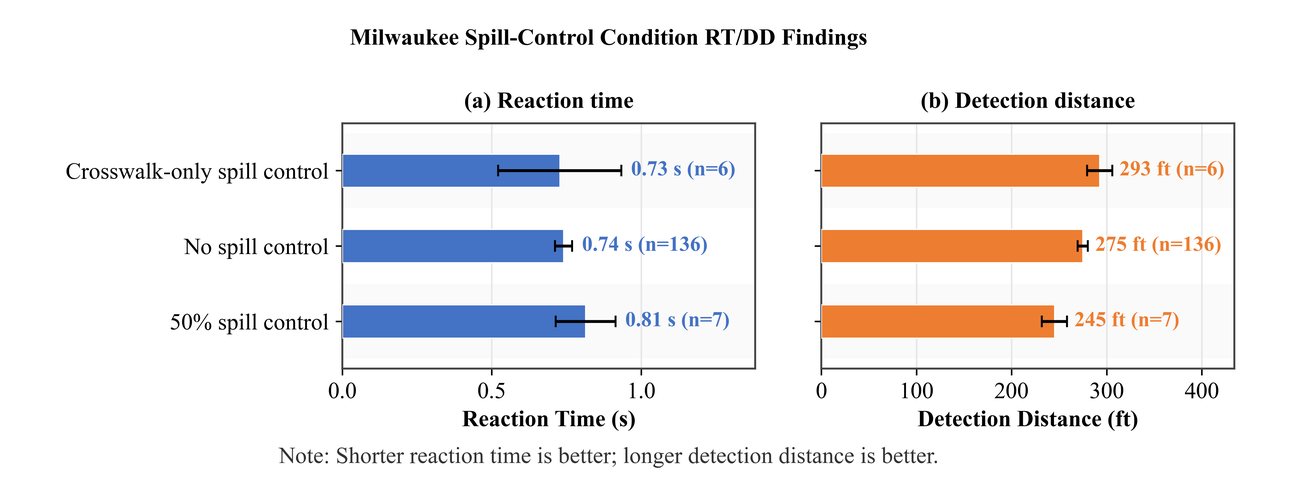
Milwaukee spill control results
Spill control

Crosswalk-only lighting showed the longest DD; limited trials, reference only.

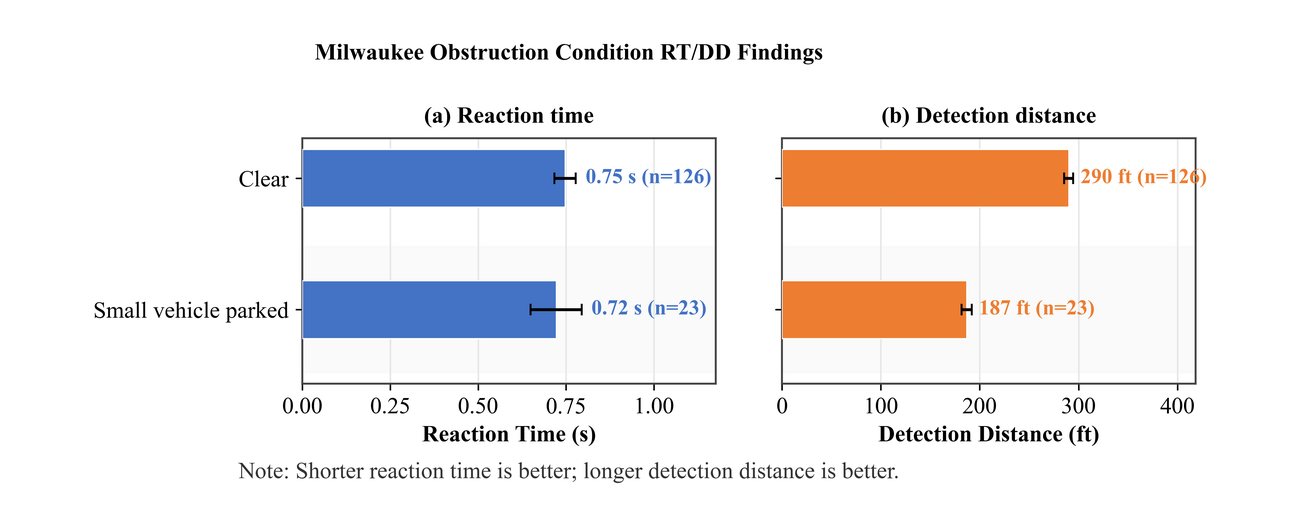
Milwaukee obstruction results
Obstruction

A parked vehicle sharply reduced detection distance; the main effect is later recognition.

Milwaukee combined configuration comparison
Combined comparison: spectrum · lateral distance · mounting height

Spectrum comparison

SpectrumRT (s)DD (ft)
Baseline (no enhanced)0.71212.0
4000 K0.66241.8
5000 K0.77251.3
6500 K0.94240.0
Blue Baseline ★0.67275.0
Ice Blue1.20221.3
Pure Royal Blue0.62209.1
Sky Blue1.13215.9

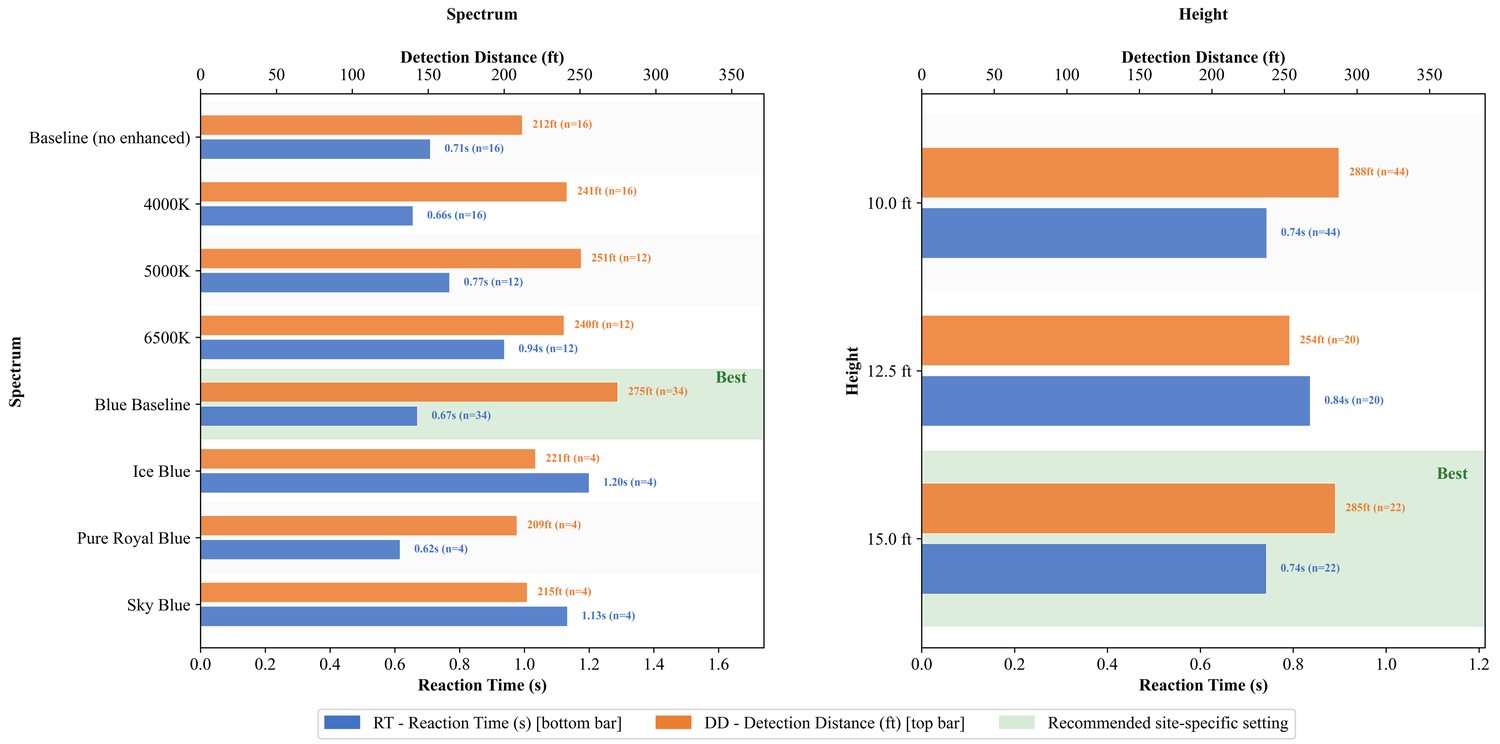
Blue Baseline strongest balanced result: +33.2 ft DD over 4000 K at unchanged RT, and +63 ft over baseline.

Madison spectrum performance comparison
Madison spectrum performance: RT & DD
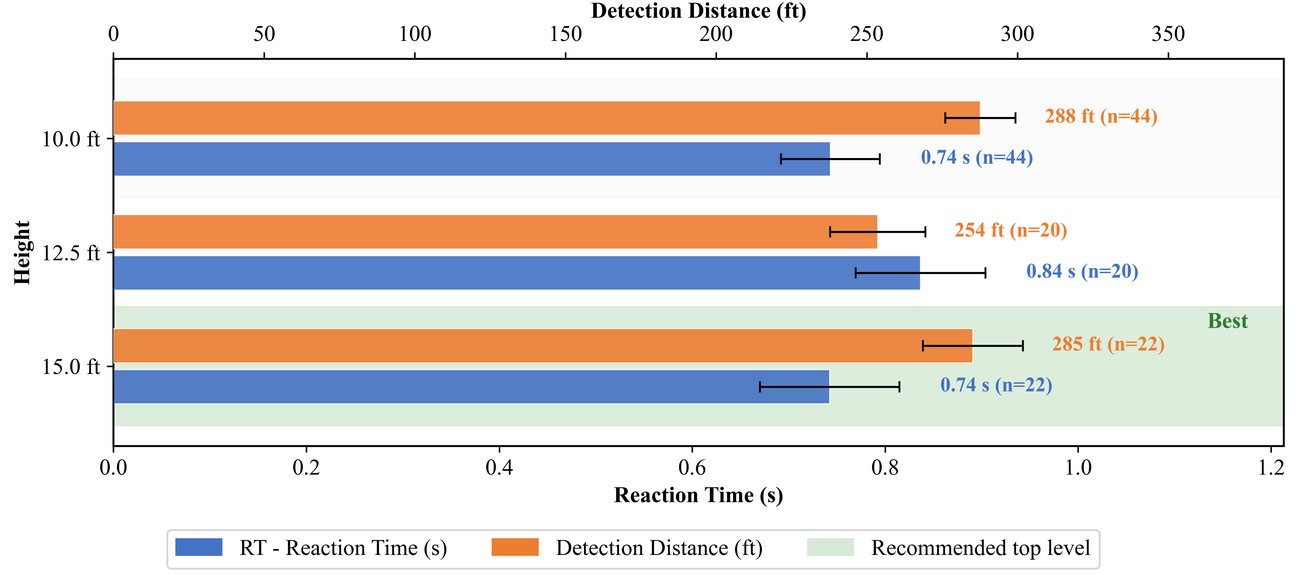
Madison mounting height comparison
Mounting height: best: 15.0 ft
Madison combined spectrum and height comparison
Combined spectrum + height comparison

Recommended Madison configuration

Spectrum: Blue Baseline Mounting height: 15.0 ft Lateral: site-specific Spill control: none

Lateral distance was not independently varied at Madison; placement was set through site review and roadway-width scaling.

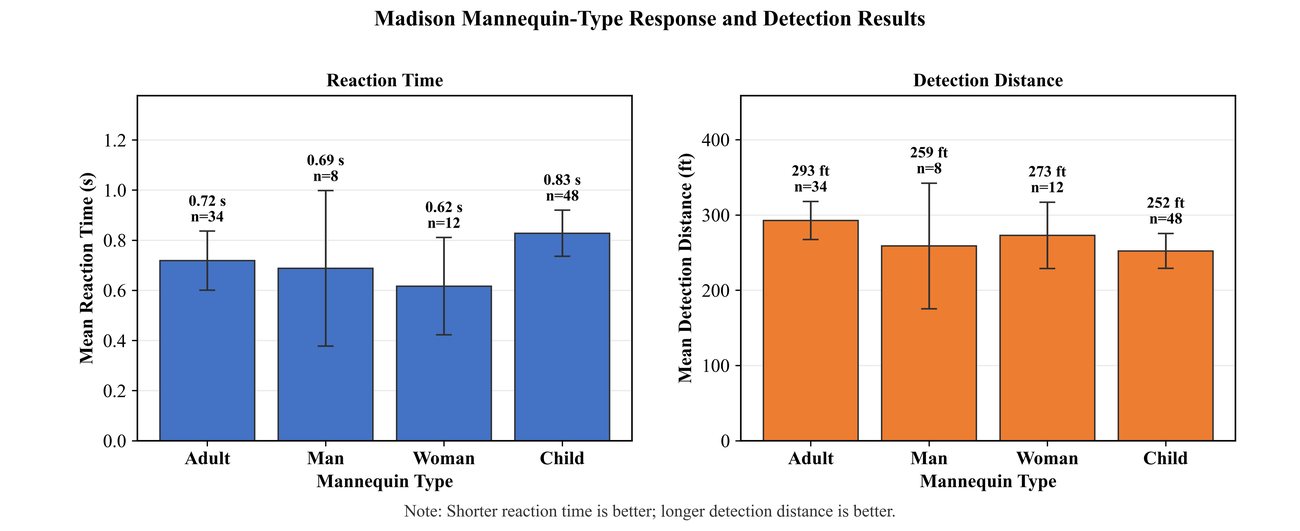
Madison mannequin type results
Mannequin type

The child mannequin had the highest RT and shortest DD; drivers recognized the smaller target later.

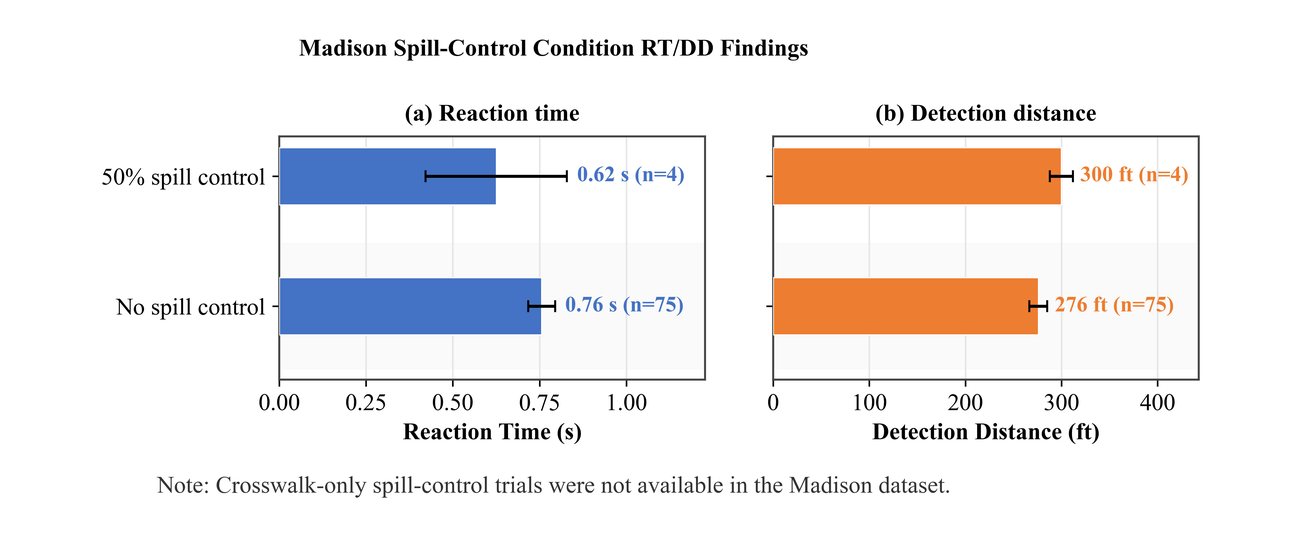
Madison spill control results
Spill control

50% spill control looked favorable but with very few trials; reference only.

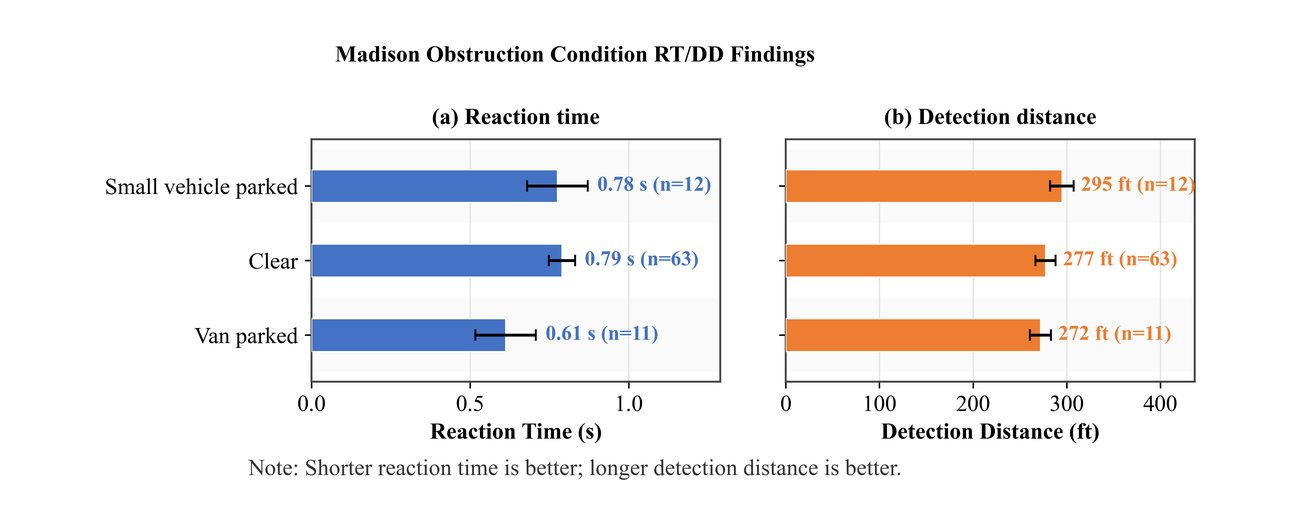
Madison obstruction results
Obstruction

Results varied by condition; drivers may have approached the larger van more cautiously.

Cross-site synthesis

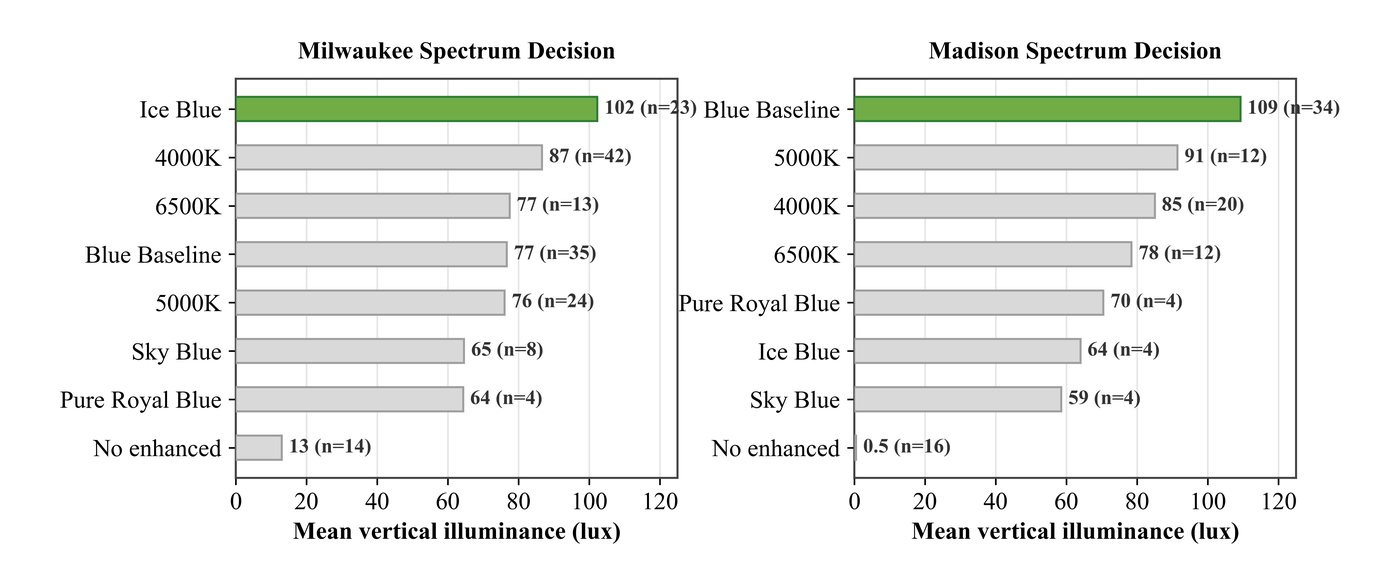
Site-specific spectrum decision rankings
Spectrum ranking: (a) Milwaukee: Ice Blue · (b) Madison: Blue Baseline
The winner depends on the road.

Ice Blue best for the two-lane residential (Milwaukee) context. Blue Baseline best for the wider urban (Madison) context, and carried forward as the generalized recommendation.

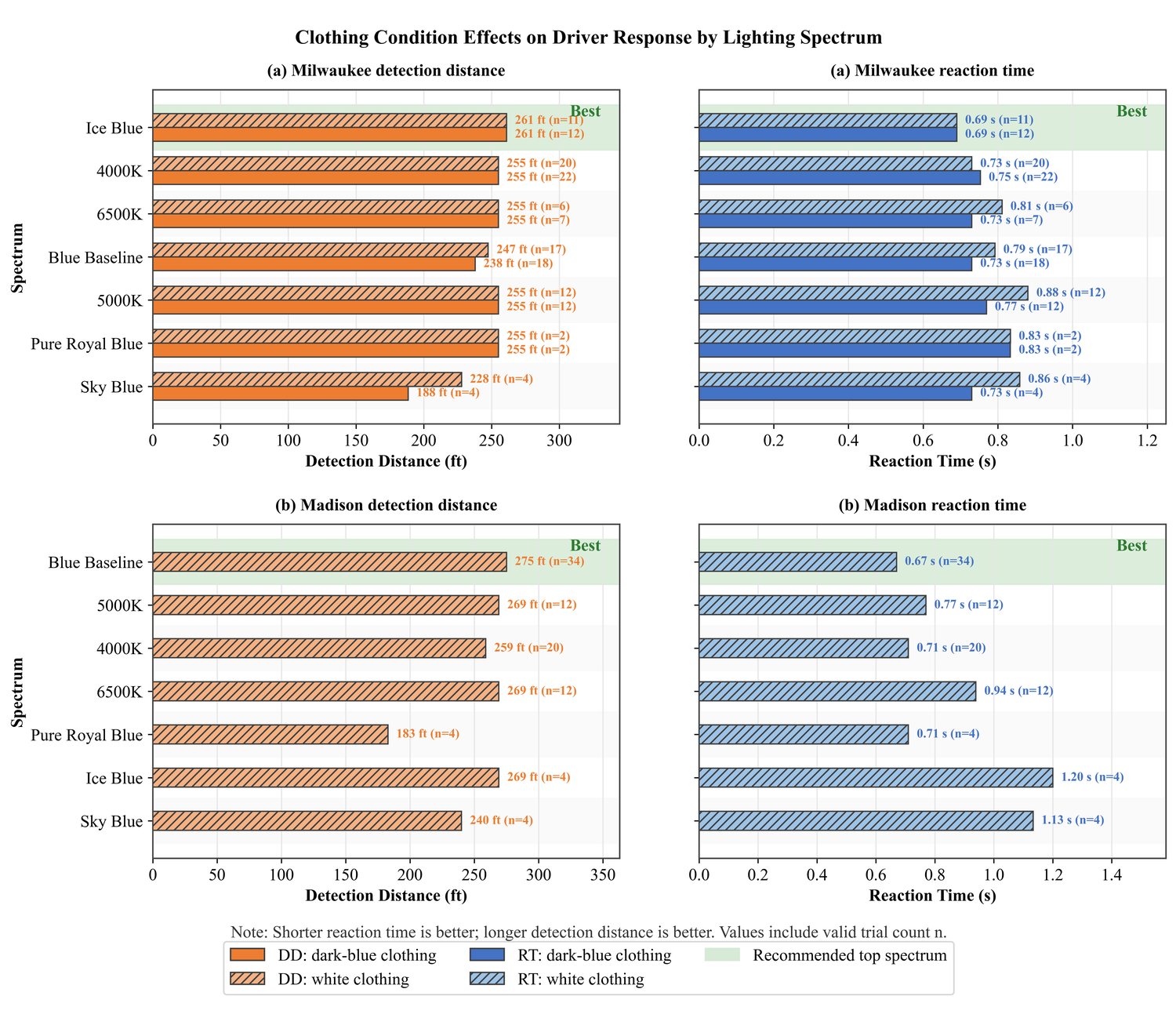
Clothing condition effects by lighting spectrum
Clothing effects: Ice Blue best at Milwaukee for both dark & white clothing; Blue Baseline best at Madison

Eye-tracking physiological metrics (N = 163)

MetricBaselineEnhancedpMeaning
Pupil diameter5.31 mm4.87 mm<0.001Pupil constriction under enhanced light
Contrast ratio0.720.88<0.001Higher pedestrian–background contrast ✓
Glare index0.180.31<0.001Increased: monitor glare in design ⚠
Visual comfort score3.823.410.002Slight comfort reduction
Blink rate0.31 /s0.22 /s<0.001Reduced blink rate
Pupil asymmetry0.080.13<0.001Greater asymmetry; possible glare indicator ⚠
Eye aspect ratio0.2840.2980.041Slightly higher under enhanced lighting
Saccade velocity142.3°/s168.7°/s<0.001Faster visual scanning ✓

Contrast and saccade gains support the visibility benefit; glare metrics justify glare review in final design.

Final recommended lighting specifications

Application contextSpectrumHeightLateralPower
2-lane residential (Milwaukee-type)Ice Blue12.5 ft9.5 ftSolar + battery
Wider urban (Madison-type)Blue Baseline15.0 ftSite-specificSolar + battery
Generalized guidanceBlue BaselineWidth-scaledWidth-scaledSolar + battery

Design illuminance ≥ 20 lux vertical at the pedestrian plane (≈ 21 lux measured in the field) · no spill control required, but glare reviewed site-specifically.

Design Guidelines

From two sites to any Wisconsin crosswalk

A planning-level framework, not a fixed standard. Every site still gets engineering review and nighttime verification.

Describe context

Width · lanes · speed · ambient lighting

Apply Blue Baseline

Spectrum from field results

Scale geometry

Height & offset from roadway width

Predict RT & DD

Blue Baseline OLS model

Screen & review

DD vs. SSD · glare · ADA

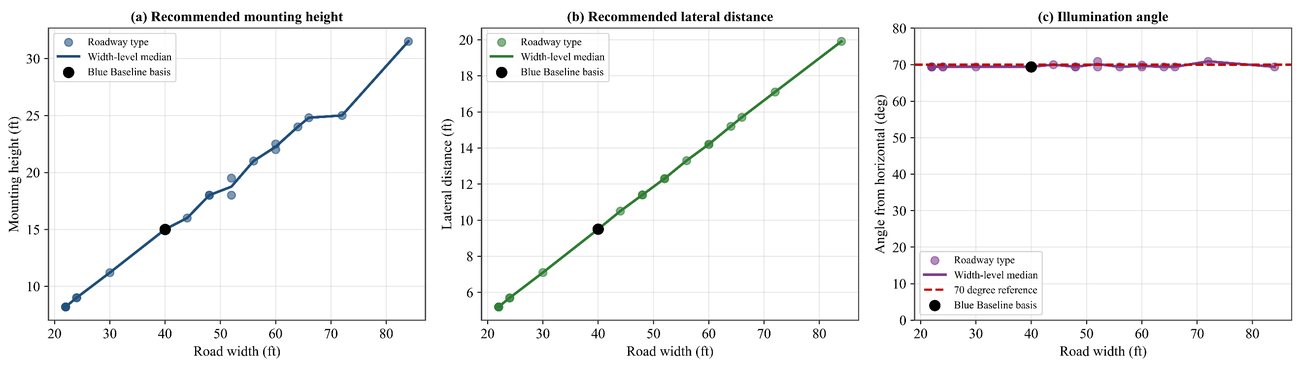
Roadway geometry scaling for mounting height and lateral placement
Height (a), lateral placement (b) & illumination angle (c) vs. road width. Example: 44 ft four-lane roadway → ≈ 16.0 ft height, ≈ 11.0 ft lateral, then verified against pole feasibility, glare, and coverage

Blue Baseline OLS models

VariableRTDD
Mounting height0.038 *1.452
Lateral distance−0.004−1.271
Road width−0.0011.395
Vehicle speed0.0127.244 **
Child vs. adult0.106−34.568
High vs. medium ambient0.065 **3.457
0.2080.451

* p < 0.1 · ** p < 0.05. The DD model (R² = 0.451) is the useful screen; predicted DD compares directly with SSD. Exploratory planning tool only.

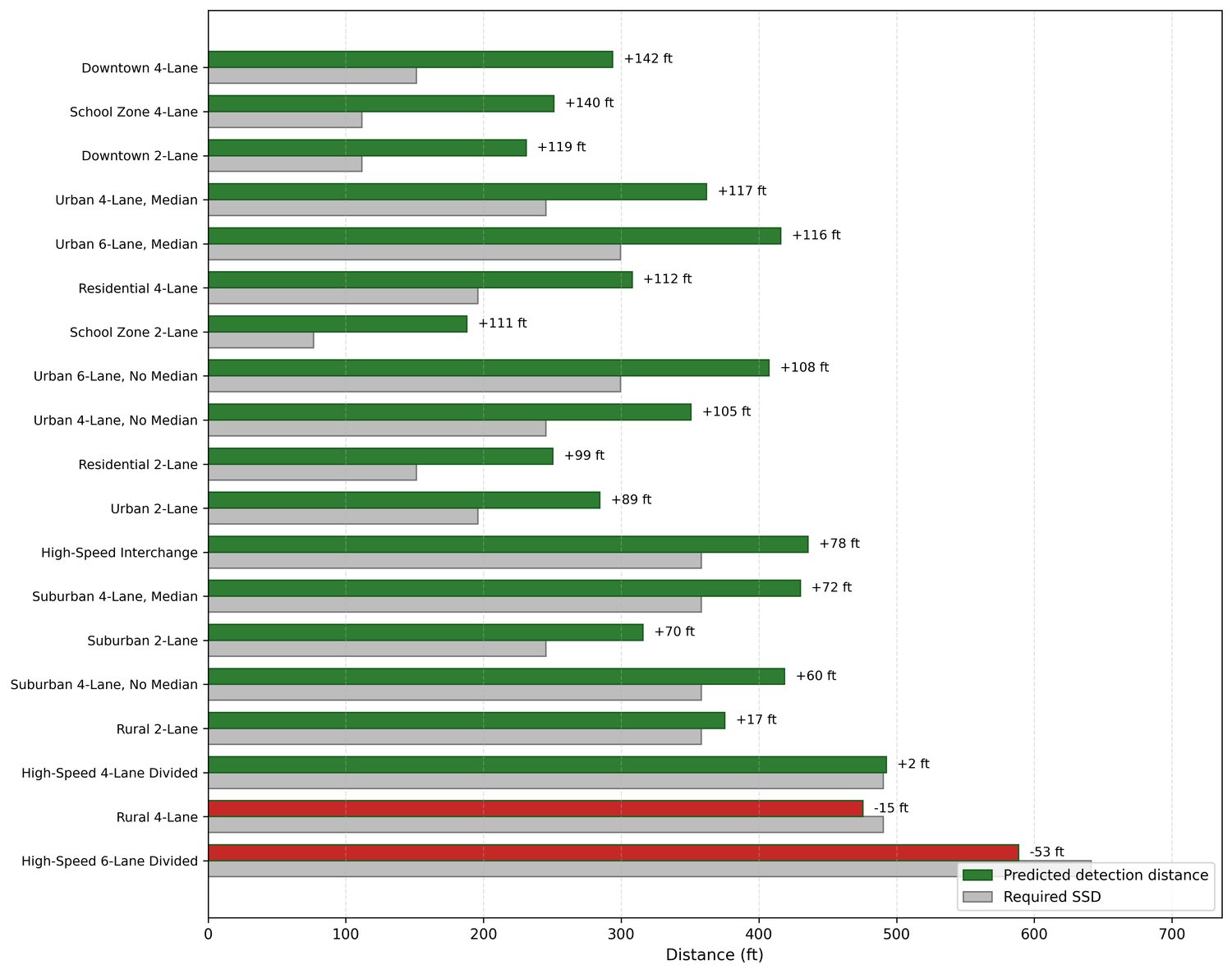
Stopping sight distance adequacy across roadway types
SSD adequacy: green: predicted DD > required SSD · red: needs design revision

Stopping sight distance screen

Predicted detection distance must exceed AASHTO-required SSD (2.5 s perception-reaction, f = 0.35, level grade).

Pass School-zone, residential, downtown, urban, most suburban

Marginal High-speed 4-lane divided: verify before advancing

Fail Rural 4-lane · high-speed 6-lane divided: revise design first

Required checks before installation

Photometric coverageVertical illumination Glare reviewBeam direction ADA clearanceClear zone UtilitiesSolar access Battery maintenanceElectrical code Median pole reviewWinter durability
For WisDOT Review

Implementation recommendations

Design elementRecommended direction
Primary spectrumBlue Baseline (blue-shifted LED; controller RGB R 129.0 · G 420.75 · B 741 on the 0–750 scale) · Ice Blue (R 80 · G 520 · B 750) for narrow two-lane residential contexts
Vertical illuminance≥ 20 lux at the pedestrian plane (≈ 21 lux measured in the field)
Mounting heightScale with roadway width (10.6 ft @ 22 ft road → 19.2 ft @ 72 ft road) · verify photometrically
Lateral placementScale with roadway width (5.6–13.7 ft) · adjust for poles, glare, coverage
Power sourceSolar + battery storage, subject to site feasibility
Safety screeningPredicted detection distance must exceed required SSD for the approach speed
1 · Lighting works

Blue-spectrum lighting reduced RT and increased DD vs. baseline at both sites.

2 · Spectrum alone isn't enough

It must combine with illuminance, contrast, coverage, glare control, and geometry.

3 · Optimal spectrum is site-dependent

Ice Blue for two-lane; Blue Baseline for wider roads and generalized use.

4 · Geometry drives transfer

Scale height and placement with roadway width; never copy between sites.

5 · SSD is the safety screen

Predicted DD must exceed required SSD, or the site needs additional review.

Next steps

Pilot deployments · larger datasets · adaptive dimming · winter validation · glare monitoring · statewide guidance updates.

Comments

Questions, corrections, and suggestions

Reviewing this study? Send a comment to the research team at UW–Milwaukee. Technical questions, data requests, implementation suggestions, and corrections are all welcome.